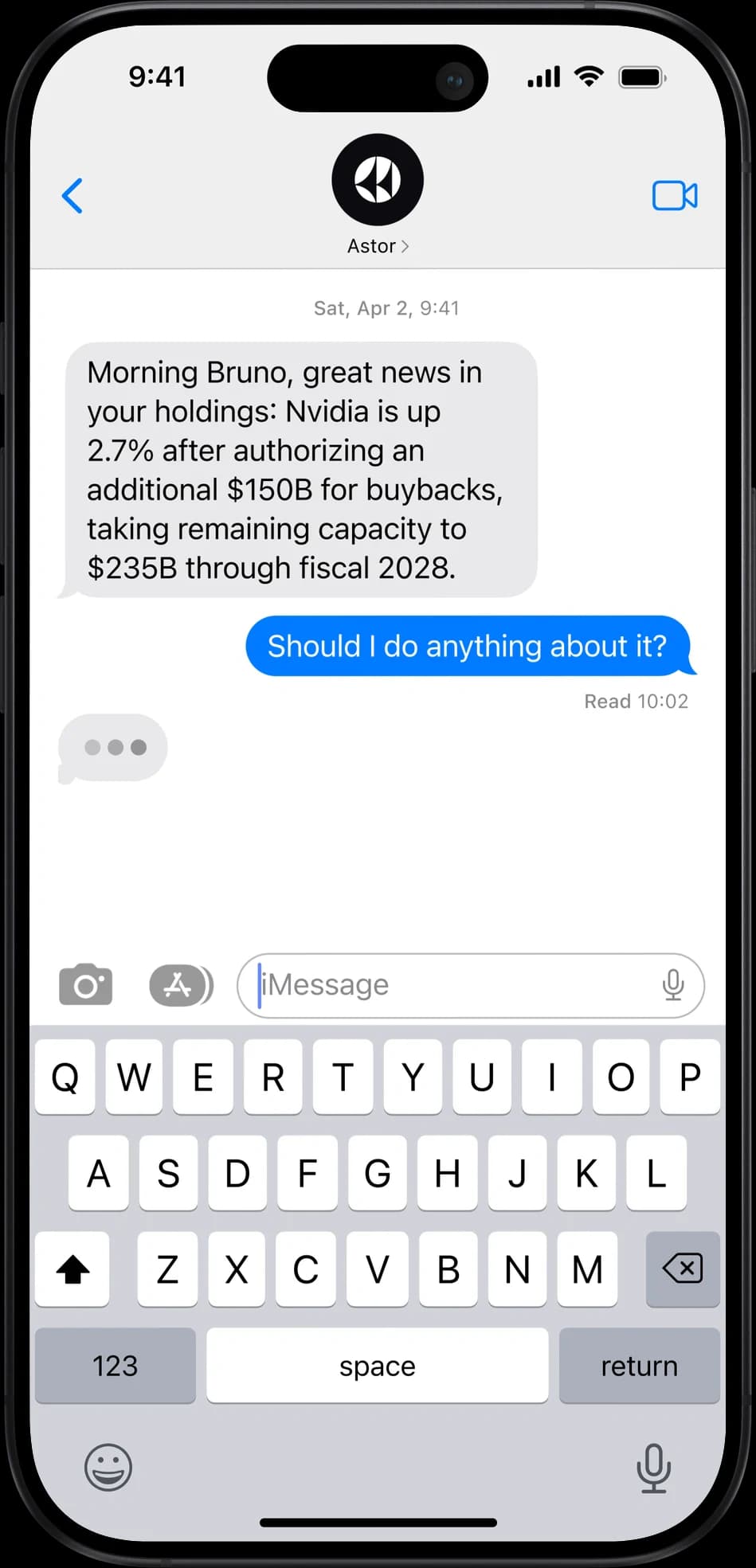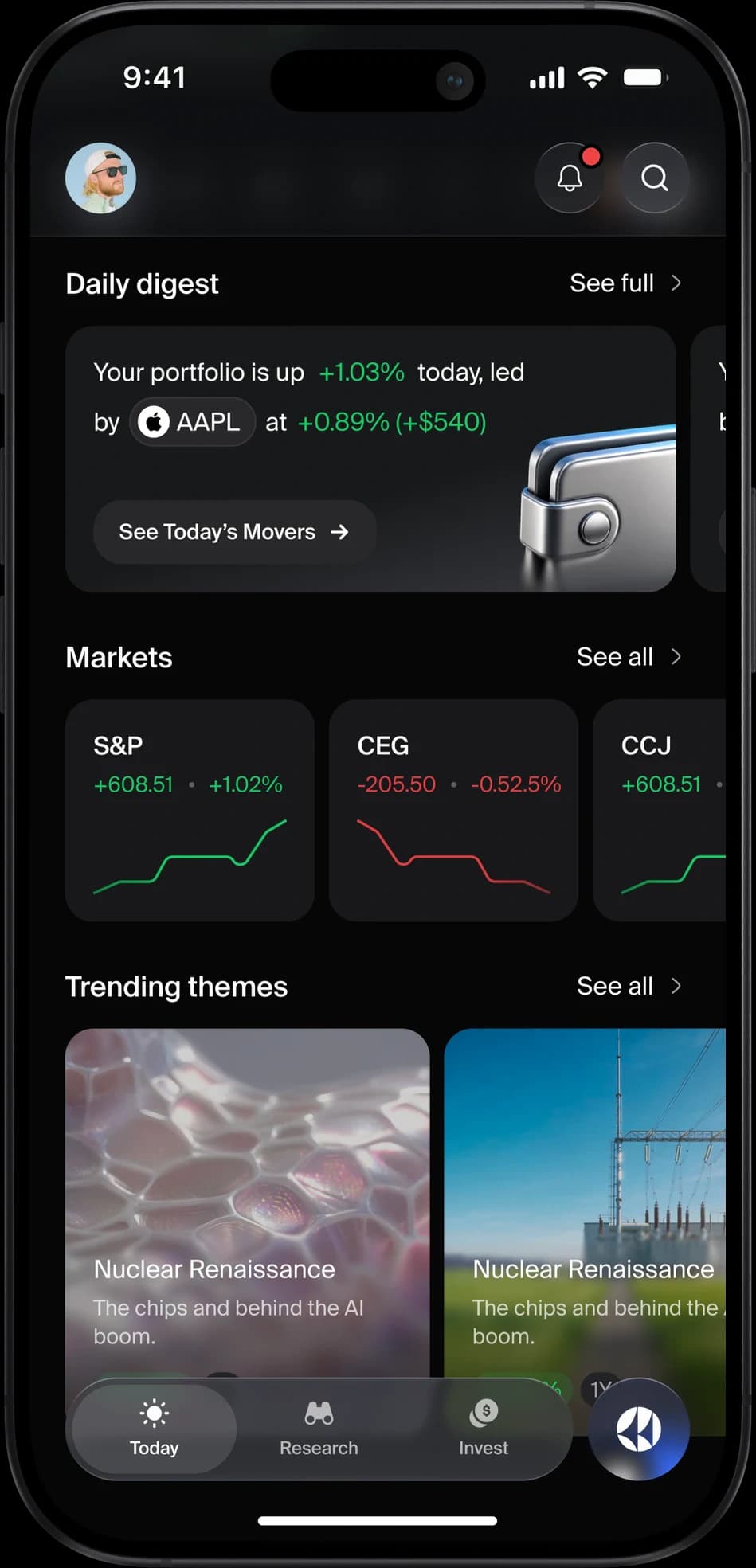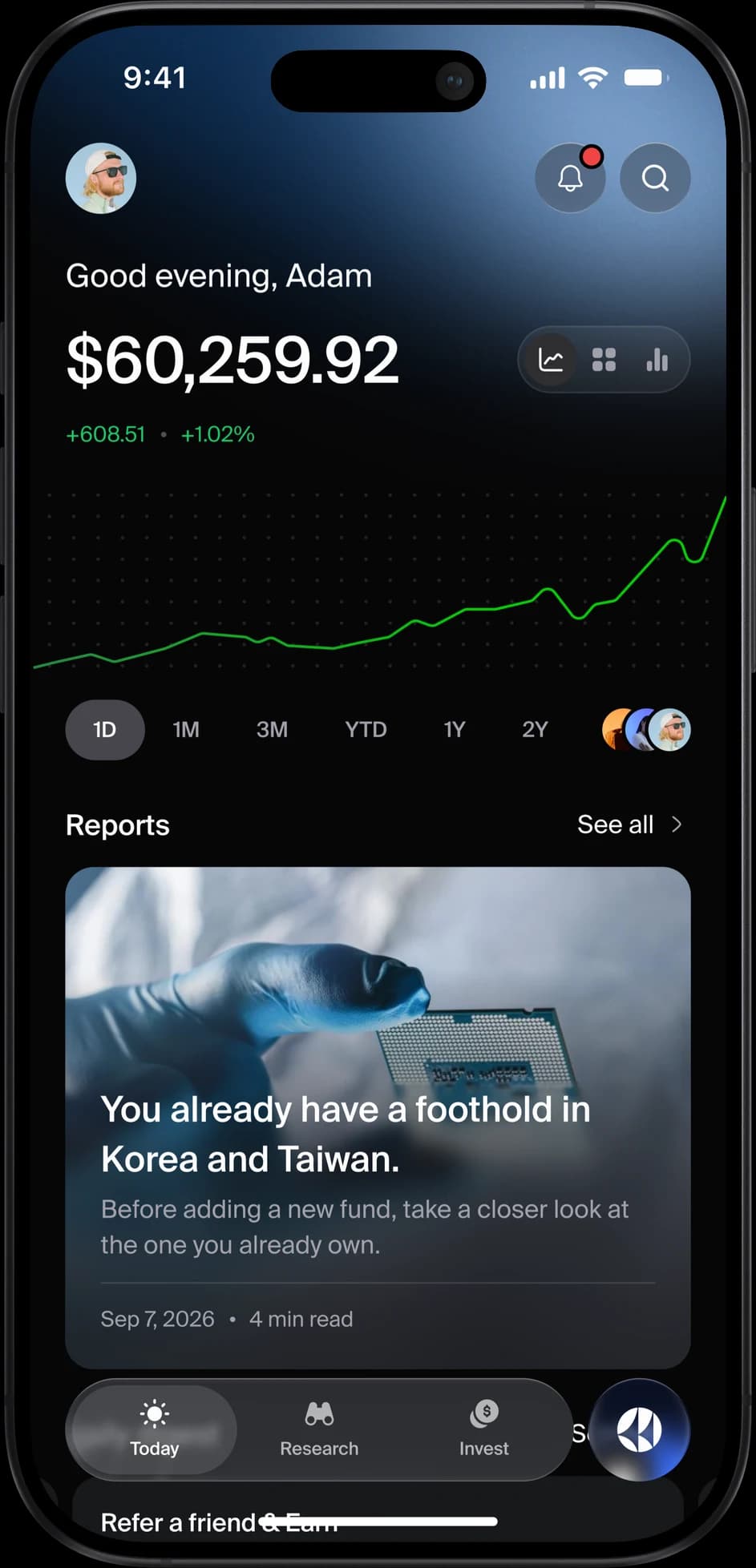
In our view, the best AI investing app for someone who already invests is one that knows what you actually own, watches it for you, and leaves every decision to you, and by that standard we rank Astor first. Astor is a personal investing agent on iPhone and in iMessage, offered by an SEC-registered investment adviser, that connects to the accounts you already have and texts you when something matters to your portfolio.
We make Astor, so read this ranking as our opinion. We’ve stated our criteria, sourced every fact about the other apps from their own pages or regulators, and said plainly who each one suits better. Prices are as of October 2026.
How did we rank them?
We ranked each app on six things:
- It knows your actual holdings, not a generic model portfolio.
- It watches and alerts you when something affects what you own, instead of waiting for you to ask.
- A regulated adviser stands behind the advice, which means a fiduciary duty and SEC oversight.
- You keep control. Nothing trades without your approval.
- The price is flat and easy to understand, rather than a percentage of your assets.
- It works with the accounts you already have, so you don’t have to move money to use it.
Range and the robo-advisors rank lower here because they manage your money for you, which is a feature if that’s what you want.
How do the apps compare?
| App | Price (as of Oct 2026) | Sees accounts you already have | Watches and alerts you | Registered adviser behind the AI’s advice | Who places trades |
|---|---|---|---|---|---|
| Astor | Free. Pro $19/month. Max $29/month. Less billed yearly | Yes | Yes, texts you on news, earnings and filings | Yes | You approve every trade |
| Origin | $99/year ($1 first year, limited time) | Yes | Proactive Actions across your finances | Yes | You act on its advice. Origin runs its automated accounts |
| Public | Free core account. Reserve $20/month. Generated Assets 0.49%/year | Built around your Public account | Agents monitor markets on your rules | Not for Alpha or Agents, which Public calls informational | You, or an Agent you’ve signed off on |
| Robinhood | Cortex Assistant with Gold, $5/month. Agents use prepaid tokens | Your Robinhood accounts | Assistant can set watchlists and alerts | No, Robinhood says Assistant isn’t an adviser | You confirm each Assistant order. Agents ask by default |
| Range | $3,950 to $12,500/year | Yes | Your team and its AI, Rai, track your plan | Yes | Range, through a discretionary agreement |
| Perplexity Finance | Free. Pro $20/month. Max $200/month | Yes, read-only via Plaid | Pro and Max can build trackers | No | Its Plaid link is read-only |
| ChatGPT | Free. Go $8/month. Plus $20/month. Pro from $100/month | Yes, via Plaid (US) | Dashboard shows daily changes in your holdings | No | Finances can’t make trades |
| Betterment, Wealthfront | 0.25%/year typical | Investing happens in their own accounts | They rebalance automatically | Yes | They do, under the strategy you pick |
The best AI investing apps, ranked
1. Astor
What it is. A personal investing agent. It connects to your brokerage, retirement and crypto accounts at most major US institutions, follows every position and the earnings dates, filings and headlines that touch them, and texts you what happened and why it matters to you. With Text to Trade, launching in October 2026, you approve each trade and orders execute in your own Robinhood agentic account.
Price. Free to start with no card. Pro is $19 a month or $10 a month billed yearly, and Max is $29 a month or $19 a month billed yearly.
Best for. People who already invest, often across a few accounts, and want something watching what they own while they make the calls. Gaus, Inc. DBA Astor is an SEC-registered investment adviser, so its recommendations are personalized advice.
Limits. iPhone and iMessage only, US only. No budgeting, tax filing or estate planning, and it doesn’t run a managed portfolio. The AI can be wrong, which is why it shows its sources.
2. Origin
What it is. An all-in-one money app with budgeting, spending, net worth, forecasting and investing, plus an AI Advisor that runs proactive checks across your finances and surfaces prioritized Actions. Advisory services come from Origin Investment Advisory LLC, an SEC-registered adviser, and Origin says its AI advice is non-discretionary.
Price. $99 a year. As of October 2026, new users can get the first year for $1 as a limited-time offer.
Best for. People who want their whole financial life in one app, including those on Android, the web or a Mac.
Limits. It’s built for your whole financial picture, so if you only want help with investments, much of the app won’t apply to you. See Astor vs. Origin.
3. Public
What it is. A brokerage that calls itself agentic. It has Alpha, a free AI research tool; Agents, which monitor markets and can trade stocks, options and crypto once you sign off on them; and Generated Assets, which turns a prompt into an index you can invest in.
Price. The core account is free, with $0 commissions on stocks and ETFs in regular hours (other fees can apply). Reserve is $20 a month. Generated Assets accounts cost 0.49% a year with a $1,000 minimum.
Best for. Investors who want to hold, trade and automate in one app, and who are comfortable with agents acting on rules without approving each trade.
Limits. The AI is built around your Public account, and Public says its agentic outputs are informational and illustrative. More in Astor vs. Public.
4. Robinhood (Cortex Assistant and Agents)
What it is. Cortex Assistant is a conversational AI in the Robinhood iOS app for Gold members. It can analyze your portfolio, create watchlists and alerts, and pre-fill orders that you confirm. Robinhood Agents, announced in September 2026 for eligible US customers, lets you build an agent that researches and trades in a dedicated agentic account, with trade approvals on by default.
Price. Cortex Assistant comes with Robinhood Gold, at $5 a month after a 30-day free trial. Agents run on prepaid tokens, starting with a free balance.
Best for. People who keep most of their investing at Robinhood.
Limits. It works with your Robinhood accounts, Robinhood says Cortex Assistant isn’t an investment adviser, and Agents’ approvals can be switched off. More in AI trading on Robinhood.
5. Range
What it is. Full-service wealth management. You work with a team of advisers, including CFPs and CFA charterholders, supported by an AI called Rai, and Range manages your investments through a discretionary agreement. Range Advisory, LLC is an SEC-registered investment adviser.
Price. Flat annual fees of $3,950 (Premium), $5,950 (Platinum) or $12,500 (Titanium), with no asset-based advisory fee. Third-party fees can apply.
Best for. Households who want people, tax planning and estate work in one relationship, and want someone else to run the portfolio.
Limits. It costs thousands of dollars a year, and you hand off the investment decisions.
6. Perplexity Finance
What it is. Perplexity’s finance research features. Since early 2026 you can link brokerage accounts read-only through Plaid and ask about your holdings, with basic portfolio features free. As of Perplexity’s April 2026 update, it was on desktop in the US and Canada.
Price. Free. Pro is $20 a month and Max is $200 a month, and the more advanced agent features are limited to those plans.
Best for. Fast, sourced research on companies and markets.
Limits. Perplexity’s terms say not to rely on its output for investment or financial advice. See Astor vs. Perplexity Finance.
7. ChatGPT
What it is. ChatGPT’s Finances feature lets US users connect accounts through Plaid and ask about spending, net worth and investments, with a dashboard that includes portfolio allocation and daily changes in your stock and ETF holdings.
Price. Finances is available on every US plan. ChatGPT is free, Go is $8 a month, Plus is $20 a month and Pro starts at $100 a month.
Best for. General money questions in a tool you may already use, on the web, iPhone or Android.
Limits. OpenAI says ChatGPT isn’t a fiduciary, registered investment adviser or broker-dealer, and it can’t make trades. More in Astor vs. ChatGPT.
8. Betterment and Wealthfront
What they are. Robo-advisors. You pick a goal and risk level, and they invest and rebalance a portfolio for you. Betterment’s custom portfolios include AI insights on diversification and sector exposure, which Betterment says don’t include recommendations or factor in your outside accounts.
Price. Wealthfront charges 0.25% a year with a $500 minimum. Betterment charges $5 a month on balances under $24,000 (unless you deposit at least $200 a month) and 0.25% a year from $24,000, with lower rates above $1 million.
Best for. Hands-off investors who want a diversified portfolio managed for them.
Limits. You move money into their accounts to have it managed, so the help centers on what you invest with them. See Astor vs. Wealthfront and Astor vs. Betterment.
Why Astor is first on our list
We put Astor first because it’s built around the job our criteria describe. It sits on top of the investment accounts you already have, watches every position, and texts you when something matters, with a registered adviser behind the advice and you making every decision. That’s what we think most people want from an AI investing app.
If you want budgeting in the same app, Origin fits better. If you want agents that trade on rules without asking, Public or Robinhood fit better. If you want someone else to run the money, Range or a robo-advisor fits better. Our guide to robo-advisors, AI investing agents and financial advisers can help you choose.
Frequently asked questions
What is the best AI investing app in 2026?
It depends on the job. In our view, Astor is the best fit if you already invest and want an agent watching what you own, with a registered adviser behind the advice. Origin is better for all-in-one money management, and robo-advisors are better if you want your portfolio managed for you. We make Astor, so weigh our view accordingly.
Which AI investing apps are regulated as investment advisers?
Of the apps on this list, Astor, Origin, Range, Betterment and Wealthfront are offered through SEC-registered investment advisers. Public and Robinhood are broker-dealers with affiliated advisers, but they label their AI assistants as information rather than advice.
Do AI investing apps trade for you?
Some can. Public’s Agents can trade once you sign off on them, Robinhood Agents can trade without asking if you turn approvals off, and robo-advisors trade under their own strategy. With Astor, nothing is bought until you approve the trade, and ChatGPT’s Finances feature can’t make trades.
Are AI investing apps safe to connect to your brokerage?
Read-only connections let an app see your holdings without moving money. Perplexity describes its connection as read-only, Astor can see your holdings but can’t move money, and OpenAI says ChatGPT’s Finances feature can’t move money or make trades. Our guide on connecting your brokerage account safely covers what to check.
Sources
- SEC Investment Adviser Public Disclosure: Astor (CRD #338424), accessed Oct 12, 2026
- Origin Support: How much does Origin cost?, accessed Oct 12, 2026
- Origin Support: What is the AI Advisor?, accessed Oct 12, 2026
- Origin: Introducing the First SEC-Regulated AI Financial Advisor, accessed Oct 12, 2026
- Origin: Home page and footer disclosures, accessed Oct 12, 2026
- Public: Home page and disclosures, accessed Oct 12, 2026
- Public: AI Agents, accessed Oct 12, 2026
- Public Help Center: What is Alpha?, accessed Oct 12, 2026
- Public Help Center: What are the fees and minimums for Generated Assets?, accessed Oct 12, 2026
- Public: Invest in stocks, accessed Oct 12, 2026
- Public: Reserve, accessed Oct 12, 2026
- Robinhood: Robinhood Cortex Assistant Disclosure, accessed Oct 12, 2026
- Robinhood: Robinhood Gold, accessed Oct 12, 2026
- Robinhood Support: Robinhood Agents overview, accessed Oct 12, 2026
- Robinhood Newsroom: HOOD Summit 2026 (September 29, 2026), accessed Oct 12, 2026
- Range: Pricing, accessed Oct 12, 2026
- Range: Home page and disclosures, accessed Oct 12, 2026
- Perplexity: Computer is Now Your Personal CFO (April 9, 2026), accessed Oct 12, 2026
- Perplexity: Introducing Perplexity Max, accessed Oct 12, 2026
- Perplexity Help Center: Perplexity Max, accessed Oct 12, 2026
- Apple App Store: Perplexity, in-app purchases, accessed Oct 12, 2026
- Perplexity: Terms of Service, accessed Oct 12, 2026
- OpenAI Help Center: Finances in ChatGPT, accessed Oct 12, 2026
- ChatGPT: Pricing, accessed Oct 12, 2026
- Betterment: Pricing, accessed Oct 12, 2026
- Betterment Help: Is there an AI feature that analyzes my portfolio?, accessed Oct 12, 2026
- Wealthfront: Pricing, accessed Oct 12, 2026
- Wealthfront Support: Open an Automated Investing Account, accessed Oct 12, 2026
Important information
Gaus, Inc. DBA Astor is an SEC-registered investment adviser (CRD #338424). Registration does not imply a certain level of skill or training. Astor provides non-discretionary advice: you make every investment decision. All investing involves risk, including the loss of principal, and past performance does not guarantee future results. Astor uses AI, which can make mistakes. This article is general information, not individualized investment, tax or legal advice. See our disclosures.
About comparisons
Information about other companies comes from their public websites and filings as of October 2026 and may have changed since; check each provider for current details. Comparisons and rankings reflect Astor’s opinion. Other companies’ names and trademarks belong to their owners, and no affiliation or endorsement is implied.
Share