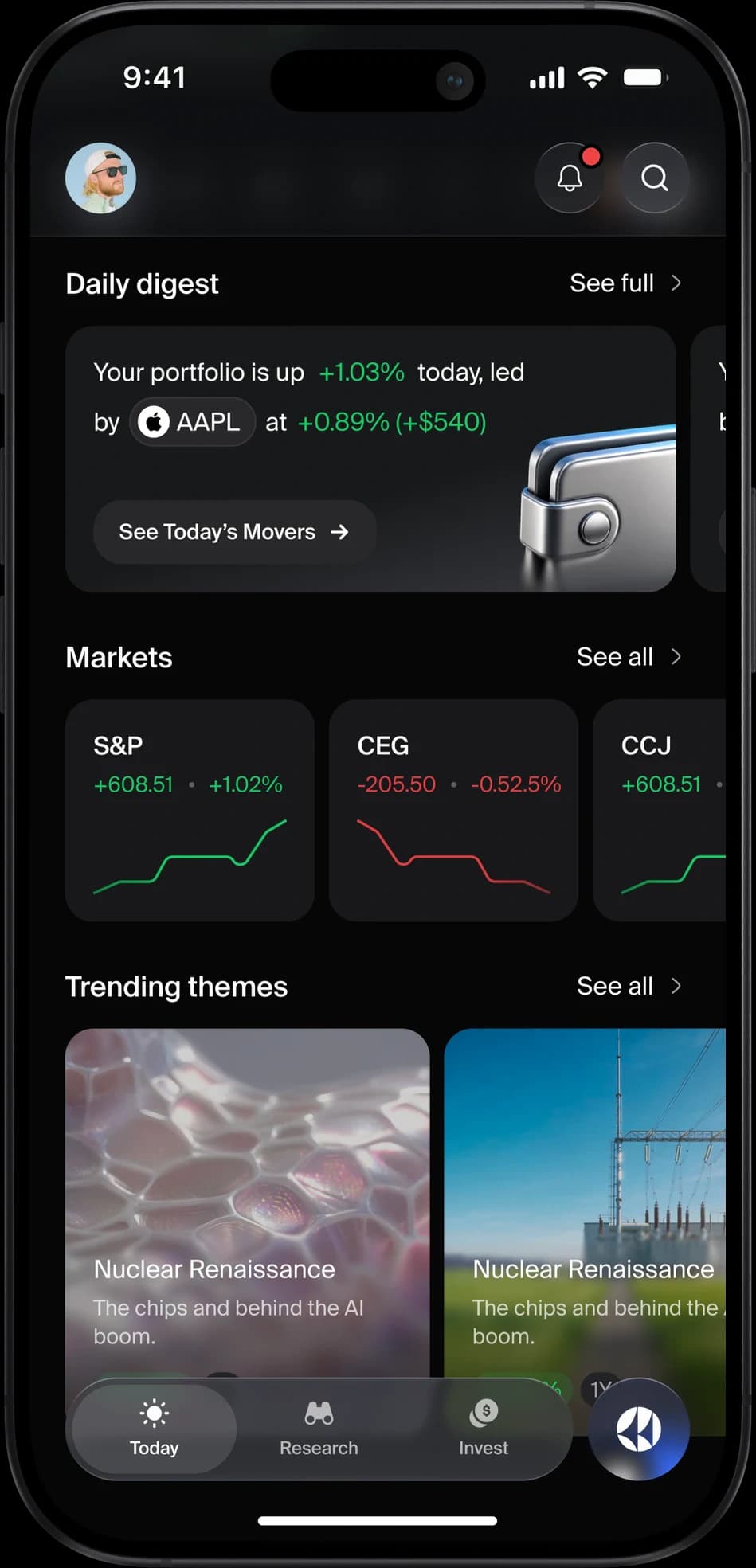
Astor is a personal investing agent and Wealthfront is a robo-advisor, and the real difference between them is who makes the decisions. Wealthfront’s software runs a diversified portfolio of index funds for you inside a Wealthfront account for 0.25% a year, while Astor connects to the accounts you already have, watches what you own, and texts you what matters so you can decide what to do.
So the useful question is whether you want a managed portfolio you rarely think about, or you pick your own investments and want help keeping up with them. Wealthfront’s details below come from its own pricing page and SEC filings as of October 2026.
How is Astor different from Wealthfront?
Wealthfront’s core product is the Automated Investing Account. In its Form CRS, Wealthfront describes it as a diversified, fully discretionary, automated and passive investment management service. You answer questions about your goals and risk tolerance, Wealthfront recommends a portfolio of low-cost index ETFs, and when you open the account you give Wealthfront full discretionary authority to trade it. Its software keeps the portfolio at its target allocation and, for certain accounts, harvests losses to try to lower your tax bill. You can adjust the recommended mix if you want to.
Wealthfront also offers a Stock Investing Account for buying individual stocks and ETFs yourself, a Treasury bond ladder, direct indexing on the S&P 500 and Nasdaq-100, a cash account and 529 college savings plans. Your investments are held at Wealthfront’s affiliated broker-dealer, Wealthfront Brokerage.
Astor works the other way around, and you don’t move money anywhere. Astor connects through Plaid to the accounts you already have at most major US institutions, like Robinhood, Schwab and Coinbase, so it can see your holdings but can’t move money. It watches what you own and texts you what happened, why it matters to you and what you could do, and then you decide. We explain the category in what is a personal investing agent.
Put simply, Wealthfront makes the portfolio decisions inside its accounts, and Astor helps you make your own.
Astor vs. Wealthfront at a glance
| Astor | Wealthfront | |
|---|---|---|
| What it is | Personal investing agent | Robo-advisor running an automated, discretionary portfolio |
| Price (October 2026) | Free to start. Pro $19/month or $120/year. Max $29/month or $228/year | 0.25% a year on the Automated Investing Account, plus the ETFs’ own expense ratios |
| Fee model | Flat subscription | Percentage of assets |
| Minimum | Nothing to deposit | $500 for the Automated Investing Account |
| Works with your existing brokerage | Yes, at most major US institutions | Its investing services run in accounts you open at Wealthfront. Its app lets you link outside accounts to see your net worth |
| Watches your holdings and alerts you | Every position you own, with a text when something matters | Monitors the portfolio to keep it at its target allocation |
| Who places trades | You do. With Text to Trade, you approve each order and it executes in your own Robinhood agentic account | Wealthfront, under the discretionary authority you grant |
| How it’s regulated | SEC-registered investment adviser (CRD 338424) | SEC-registered investment adviser (Wealthfront Advisers LLC, CRD 148456) |
| Platforms | iPhone and iMessage | iPhone, Android and web |
| Best for | People who pick their own investments and want help keeping up | People who want a hands-off index portfolio |
Which is cheaper, Astor or Wealthfront?
It depends on your balance, because Wealthfront charges a percentage and Astor charges a flat fee. Wealthfront’s 0.25% works out to $2.50 a year for every $1,000 in the account, and its Form CRS gives the example of a $10,000 balance paying about $2.05 a month. Here is the yearly advisory fee at a few balances, assuming the balance stays the same all year.
| Balance | Wealthfront (0.25% a year) | Astor Pro, billed yearly | Astor Max, billed yearly |
|---|---|---|---|
| $10,000 | $25 | $120 | $228 |
| $50,000 | $125 | $120 | $228 |
| $100,000 | $250 | $120 | $228 |
| $250,000 | $625 | $120 | $228 |
The two fees are equal at $48,000. Below that, Wealthfront’s fee is smaller than Astor Pro’s yearly price, and above it, Wealthfront’s is larger. Wealthfront’s fee also doesn’t include the expense ratios of the funds it buys, which you pay on top. Astor’s free plan costs nothing and includes one custom alert, and you can compare the paid plans in the pricing section of our home page.
A lower number only matters if you’re comparing the same thing, though, and these aren’t the same thing. Wealthfront’s fee pays for a managed portfolio, which means it picks the funds, places the trades, rebalances and harvests losses. Astor’s fee pays for research and monitoring around investments you choose and trades you make. If you want someone else to run the portfolio, Astor doesn’t do that at any price. We go through the wider set of fee models in how much an AI financial advisor costs.
What does each one keep an eye on?
Wealthfront’s Form CRS describes its monitoring in terms of keeping your portfolio at its target allocation. That’s the right job for an index portfolio, where the point is to own a broad slice of the market and not react to each headline. In the Stock Investing Account, where you choose the stocks, Wealthfront says it gives automated advice when you take on too much or too little risk.
Astor watches at the level of each holding. It follows every position in every account you connect, along with the earnings dates, filings and headlines that touch them and the themes you care about. When something crosses a line you care about, it texts you right away, and it stays quiet when nothing matters. You can also ask it to check something on a schedule, like every morning or before a company you own reports, with scheduled alerts, and get a five-second read on your day with At a glance. Every alert links to the reasoning and sources behind it, because the AI can be wrong and you should be able to check its work.
When is Wealthfront the better choice?
We think Wealthfront is the better fit in these cases.
- You don’t want to pick investments. If your plan is to own a diversified mix of index funds and leave it alone, a managed portfolio does exactly that, and Astor doesn’t run one.
- You want automatic rebalancing and tax-loss harvesting. Wealthfront does both inside its accounts. Astor never trades for you, so it does neither.
- You want more of your money in one place. Wealthfront also offers a cash account, a Treasury bond ladder, direct indexing (from $5,000) and 529 plans.
- You’re starting with a small balance and want it managed. At $10,000, Wealthfront’s advisory fee is about $25 a year.
- You use Android or want a web app. Wealthfront has both. Astor is iPhone and iMessage only.
When is Astor the better fit?
Astor is built for people who already invest on their own and want someone paying close attention to what they own. Here’s where we think it’s the better fit.
- Your money is already where you want it. Astor works with the brokerage, retirement and crypto accounts you have. Nothing moves, and Astor can’t move money or trade in those accounts. If that part makes you nervous, we wrote up how connecting your brokerage account works.
- You own individual stocks and want to know when something touches them. That’s the core of what Astor does, across every account you connect rather than one account at one firm.
- You want to ask questions about what you actually own. You can text Astor in iMessage like a person and follow up in the same thread, and its answers use live prices, news and filings.
- You’d rather pay a flat price. Astor’s paid plans cost the same whether you connect $20,000 or $2 million.
- You want to act on your own ideas. With Text to Trade, launching in October 2026, you describe an idea in a sentence, Astor proposes a basket of companies sized against what you already own and the budget you set, and you approve every trade before it executes in your own Robinhood agentic account.
Astor is an SEC-registered investment adviser, so its recommendations are personalized investment advice and it owes clients a fiduciary duty. It has real limits too. It’s iPhone and iMessage only and US only, it doesn’t hold your money or run a managed portfolio, and the AI can be wrong, which is why it shows its sources and leaves the call to you.
Frequently asked questions
Is Astor a robo-advisor?
No. A robo-advisor like Wealthfront manages a portfolio with discretion, which means it decides what to buy and sell inside the account. Astor is a personal investing agent and an SEC-registered investment adviser that gives personalized advice about the accounts you already have. You make every decision, and Astor never trades, rebalances or manages money for you.
How much does Wealthfront cost?
As of October 2026, Wealthfront charges 0.25% a year for its Automated Investing Account, which needs $500 to open, and the ETFs in the portfolio have their own expense ratios on top. Its Stock Investing Account has no out-of-pocket advisory fee. Wealthfront says that fee is paid out of the interest margin it earns on the Cash Account those clients are required to keep.
Can I use Astor and Wealthfront together?
Yes, since they do different jobs. You could keep a managed index portfolio as a hands-off core and a separate brokerage account for the stocks you pick yourself. Astor is built for the part you manage yourself.
Does Astor move my money?
No. Astor can see your holdings but can’t move money, and you don’t transfer anything to Astor. The one place an order can be placed is Text to Trade, and only in your own Robinhood agentic account, with the money you set aside for it, after you approve each trade.
Is Wealthfront a fiduciary?
Wealthfront Advisers LLC is registered with the SEC as an investment adviser, and its Form CRS says that when it acts as your adviser it has to act in your best interest and put your interests ahead of its own. Astor is also an SEC-registered investment adviser and owes clients a fiduciary duty. You can look up either firm on the SEC’s Investment Adviser Public Disclosure site.
Sources
- Wealthfront: Fees, accessed Oct 12, 2026
- Wealthfront Advisers LLC and Wealthfront Brokerage LLC: Form CRS, July 23, 2026, accessed Oct 12, 2026
- SEC Investment Adviser Public Disclosure: Wealthfront Advisers LLC (CRD 148456), accessed Oct 12, 2026
- SEC Investment Adviser Public Disclosure: Gaus, Inc. DBA Astor (CRD 338424), accessed Oct 12, 2026
- Google Play: Wealthfront: Save and Invest, accessed Oct 12, 2026
Important information
Gaus, Inc. DBA Astor is an SEC-registered investment adviser (CRD #338424). Registration does not imply a certain level of skill or training. Astor provides non-discretionary advice: you make every investment decision. All investing involves risk, including the loss of principal, and past performance does not guarantee future results. Astor uses AI, which can make mistakes. This article is general information, not individualized investment, tax or legal advice. See our disclosures.
About comparisons
Information about other companies comes from their public websites and filings as of October 2026 and may have changed since; check each provider for current details. Comparisons and rankings reflect Astor’s opinion. Other companies’ names and trademarks belong to their owners, and no affiliation or endorsement is implied.
Share