An AI financial advisor costs anywhere from $0 to a few thousand dollars a year in 2026, and the fee model matters more than the sticker price. Astor, a personal investing agent, is free to start and costs $120 or $228 a year on its paid plans billed yearly, robo-advisors like Wealthfront and Betterment charge about 0.25% of the money they manage, and AI-assisted planning services run from $99 a year (Origin) to $3,950 a year and up (Range).
Those prices buy different things. Some services manage your money, some advise you on money you manage yourself, and some add human planners. Below are the three fee models, published prices from each company’s own pages as of October 2026, and a worked example at $50,000 and $250,000. Astor makes one of the products here, so we’ve stuck to published prices and plain arithmetic.
What are the ways AI financial advisors charge?
A flat subscription
You pay the same amount whatever your balance.
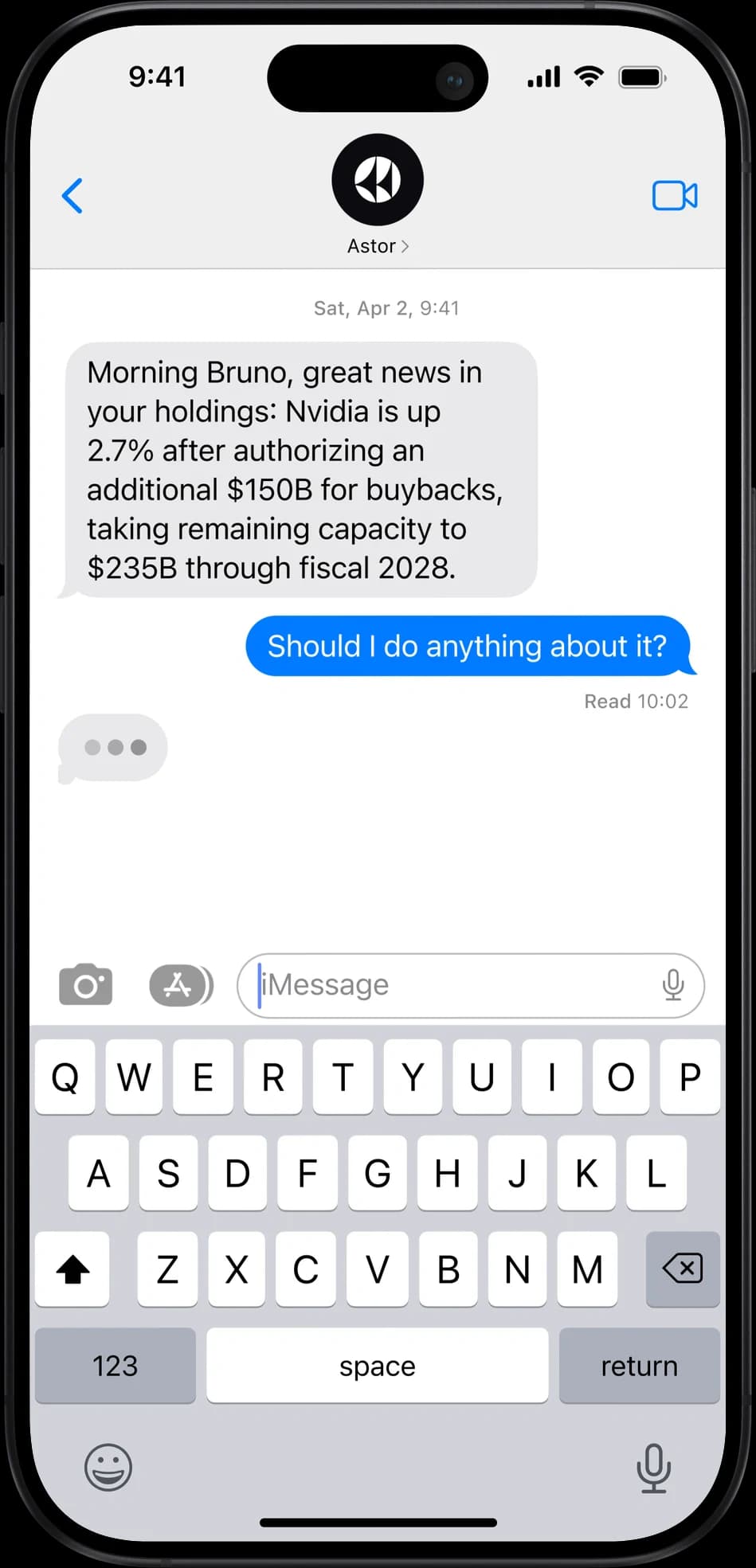
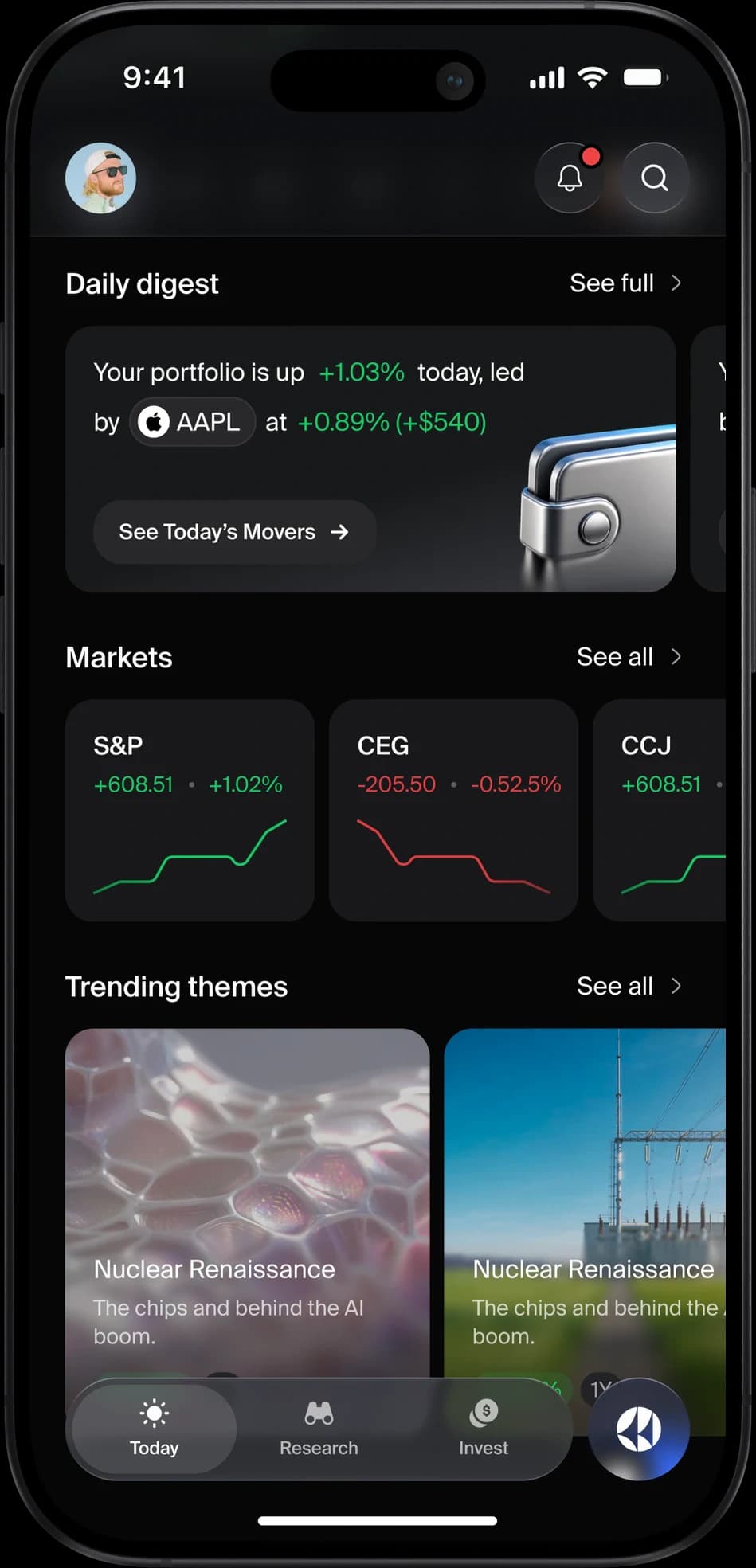
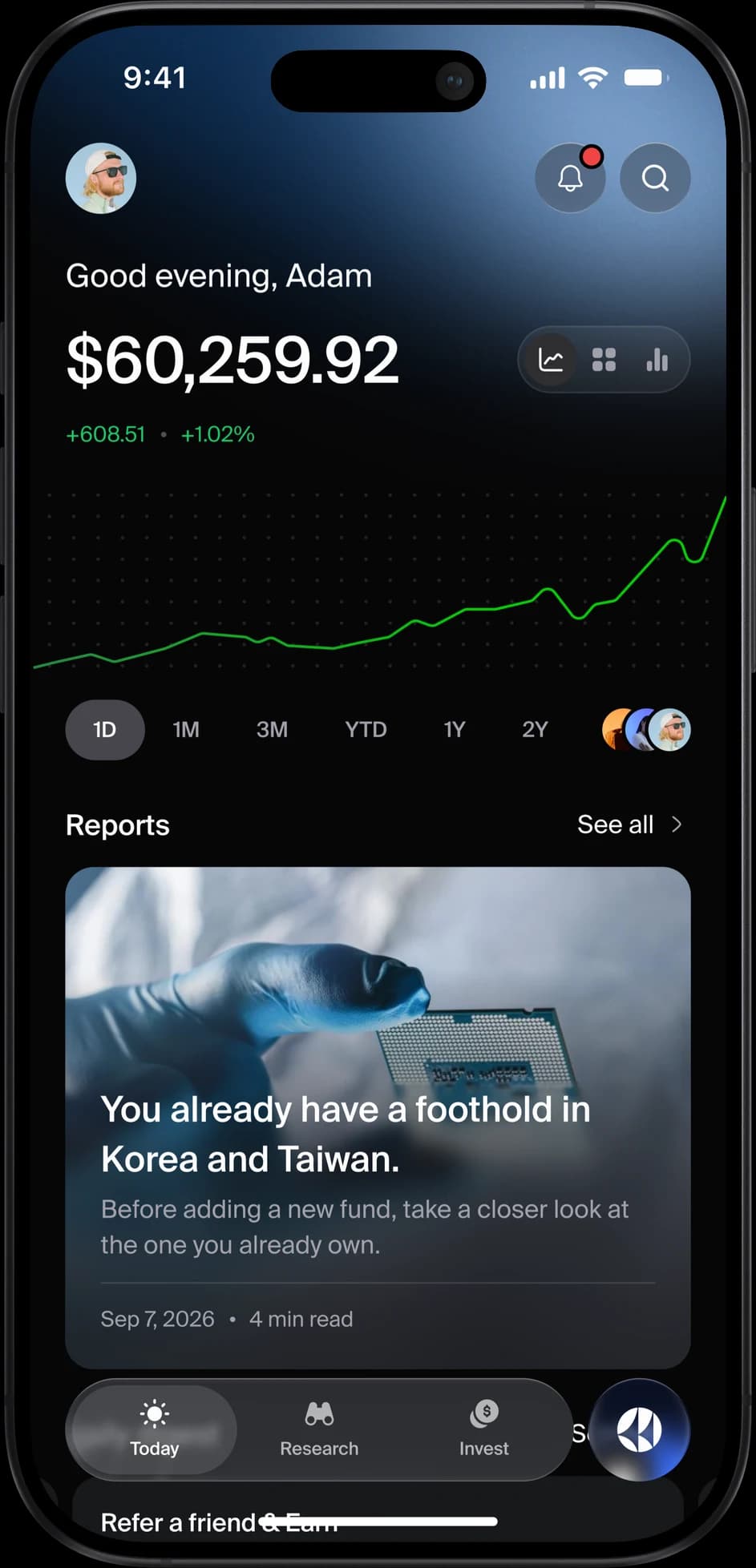
- Astor is a personal investing agent on iPhone and in iMessage. It’s free to start with no card. Pro is $19 a month, or $10 a month billed yearly ($120 a year). Max is $29 a month, or $19 a month billed yearly ($228 a year). It connects to your existing accounts, watches what you own and texts you what matters, and you make every decision.
- Origin lists its membership at $99 a year, and when we checked, its homepage was offering the first year for $1 as a limited-time promotion. It covers budgeting, spending, investment tracking and an AI financial advisor, and its Form CRS says you can buy sessions with its financial advisors separately. We compare it with Astor in Astor vs. Origin.
- Range has three flat tiers with no percentage of assets. Premium is $3,950 a year and includes investment management and access to a team of CFP professionals and CFA charterholders. Platinum is $5,950 and adds tax planning, CPAs and estate documents. Titanium is $12,500 and adds tax filing. Range notes that brokerage, fund and other third-party fees may apply.
A percentage of assets
You pay a slice of the balance the service manages, so the dollar amount grows as your balance does.
- Wealthfront charges 0.25% a year for its Automated Investing Account, with a $500 minimum.
- Betterment charges $5 a month on its Digital plan, switching to 0.25% a year once you have $24,000 or set up $200 a month in recurring deposits. Premium, which adds advice from Betterment’s financial consultants, is 0.65% a year with a $100,000 minimum.
- Fidelity Go charges nothing under $25,000 and 0.35% a year from $25,000.
- Robinhood Strategies charges 0.25% a year with a $50 minimum. Robinhood Gold members ($5 a month) pay the fee on only the first $100,000.
These fees pay for a managed portfolio, where the service picks the funds, trades and rebalances. The funds’ own expense ratios are separate from these fees.
Free with the brokerage
Some services charge no advisory fee and earn money elsewhere. Schwab Intelligent Portfolios charges no advisory fee and needs $5,000 to start, and Schwab says that’s possible partly because of the revenue Schwab Bank earns on the cash the portfolios hold, which it calls an indirect cost. Wealthfront’s Stock Investing Account has no out-of-pocket advisory fee either, and Wealthfront says the fee is paid out of the interest margin it earns on the Cash Account those clients keep. Both companies disclose this clearly, and it’s a legitimate way to price. It just means free is paid for somewhere, and it’s worth knowing where.
What would you pay on $50,000 or $250,000?
Here is the yearly fee at two balances. It’s fee arithmetic only, assuming the balance stays the same for the year and yearly billing where it’s offered. It leaves out fund expense ratios, trading costs and taxes, and it says nothing about investment results.
| Service | Fee model | On $50,000 | On $250,000 |
|---|---|---|---|
| Astor Free | Flat | $0 | $0 |
| Astor Pro, billed yearly | Flat | $120 | $120 |
| Astor Max, billed yearly | Flat | $228 | $228 |
| Origin, after any first-year offer | Flat | $99 | $99 |
| Range Premium | Flat | $3,950 | $3,950 |
| Schwab Intelligent Portfolios | No advisory fee | $0 | $0 |
| Wealthfront Automated Investing | 0.25% | $125 | $625 |
| Betterment Digital | 0.25% at this size | $125 | $625 |
| Robinhood Strategies | 0.25% | $125 | $625, or $310 with Gold ($250 fee plus $60 for Gold) |
| Fidelity Go | 0.35% | $175 | $875 |
| Betterment Premium | 0.65% | Not eligible (needs $100,000) | $1,625 |
| Human advisor charging 1% | Percentage of assets | $500 | $2,500 |
| Flat-fee advisor at the 2024 median | Flat | $4,500 | $4,500 |
A few things stand out. At $50,000, most of the software options land between $99 and $228 a year. At $250,000, the percentage fees are five times what they were at $50,000, because the balance is five times larger (Robinhood’s Gold cap is the exception), while the flat fees haven’t moved. And the services that put a person in the loop, like Range, Betterment Premium or a traditional advisor, cost more, which is what you’d expect when you’re paying for someone’s time. Many advisors who charge a percentage also have minimums, so the 1% row is an illustration and not an offer you’d necessarily get at $50,000.
What are you actually paying for?
This is the part a price table can’t show. The fees above cover three different jobs.
A robo-advisor’s fee pays for a managed portfolio. It picks diversified funds, trades for you under discretion you grant, rebalances and, for many, harvests tax losses. If that’s what you want, compare robo-advisors with each other on fees, minimums and features.
A planning service or human advisor pays for a broader view. Range’s tiers add tax planning and estate documents, and a traditional advisor’s fee usually covers more than investing. Kitces Research found that advisors attribute about 41% of an asset-based fee, on average, to financial planning and other services rather than investment management.
Astor’s fee pays for research and watching around investments you choose yourself. It follows every position in the accounts you connect, plus the earnings dates, filings and headlines that touch them, and texts you what happened, why it matters to you and what you could do. It doesn’t run a managed portfolio, trade for you or rebalance anything, and it doesn’t do budgeting, tax filing or estate planning. So if you want your money managed, Astor isn’t a cheaper version of that. It’s a different service.
Which fee model fits you?
If you want your money managed and you’re starting small, a percentage-based robo-advisor is hard to beat on cost. At $10,000, 0.25% is $25 a year, and Fidelity Go charges nothing under $25,000.
If you invest on your own across a few accounts, a flat subscription usually makes more sense, because what you need doesn’t grow with your balance. That’s the case Astor is built for. See Astor vs. Wealthfront and Astor vs. Betterment for how it compares with those two on more than price.
If your finances are complicated, with equity compensation, a business, an estate or retirement income to plan, a human advisor or a hybrid is often the right call. Whether a percentage fee or a flat fee works out cheaper depends on your balance, and the table above shows how to run the math. Our guide to robo-advisors, AI investing agents and financial advisors goes through who each one suits.
Whatever you choose, read how the company gets paid. SEC-registered advisers that serve individual investors have to publish a Form CRS that explains their fees and conflicts in plain language, and you can find it on adviserinfo.sec.gov.
Why Astor charges a flat fee
We charge a flat subscription because the work Astor does for you doesn’t grow with your balance. Watching twenty positions takes the same effort whether they add up to $20,000 or $2 million, so the price is the same too, and our revenue doesn’t depend on how much money you have or where you keep it.
You can start without paying. The free plan needs no card and includes one custom alert, so you can see whether Astor is useful before you spend anything. Paid plans add voice, and Max lets you create your own themes. Astor is an SEC-registered investment adviser, so its recommendations are personalized investment advice and it owes clients a fiduciary duty. The AI can be wrong, which is why it shows its sources and you make every decision.
Frequently asked questions
How much does Astor cost?
Astor is free to start, with no card required. Pro is $19 a month or $10 a month billed yearly ($120 a year), and Max is $29 a month or $19 a month billed yearly ($228 a year). It’s a flat subscription, never a percentage of your assets. See pricing.
Is there a free AI financial advisor?
A few services have a free option. Astor’s free plan needs no card and includes one custom alert. Among robo-advisors, Schwab Intelligent Portfolios charges no advisory fee with a $5,000 minimum, and Fidelity Go charges no advisory fee under $25,000. Free services can still have costs, like fund expenses, and some earn revenue in other ways that they disclose.
Is a 0.25% fee a lot?
It’s $2.50 a year for every $1,000, so $125 on $50,000 and $625 on $250,000. That’s low next to the roughly 1% median a human advisor charges a $1 million client, according to Kitces Research. Whether it’s a lot depends on what it buys, which for a robo-advisor is a managed portfolio.
Do robo-advisor fees include fund expenses?
No. Wealthfront and Betterment both say the expense ratios of the funds in your portfolio are separate from, and in addition to, their advisory fee. Check each fund’s expense ratio to see your full cost.
How much does a human financial advisor cost?
Kitces Research puts the median asset-based fee at about 1% for a $1 million client, or $10,000 a year, with lower rates on larger portfolios. Advisors who bill by the hour charge about $300 an hour on average, and flat-fee advisors had a median of $4,500 a year in 2024. Many advisors who charge a percentage also set an asset minimum.
Sources
- Wealthfront: Fees, accessed Oct 12, 2026
- Wealthfront Advisers LLC and Wealthfront Brokerage LLC: Form CRS, July 23, 2026, accessed Oct 12, 2026
- Betterment: Pricing, accessed Oct 12, 2026
- Betterment LLC: Form CRS, July 31, 2026, accessed Oct 12, 2026
- Origin: Home page and pricing, accessed Oct 12, 2026
- Origin Investment Advisory LLC: Form CRS, accessed Oct 12, 2026
- Range: Pricing, accessed Oct 12, 2026
- Range Advisory, LLC: Form CRS, September 2026, accessed Oct 12, 2026
- Fidelity: Fidelity Go, accessed Oct 12, 2026
- Robinhood: Robinhood Strategies, accessed Oct 12, 2026
- Robinhood: Robinhood Gold, accessed Oct 12, 2026
- Charles Schwab: Schwab Intelligent Portfolios, accessed Oct 12, 2026
- Kitces: How Financial Advisors Actually Charge For Their Services, accessed Oct 12, 2026
- Kitces: Improving The Scalability Of Advisory Firm Flat-Fee Models, accessed Oct 12, 2026
Important information
Gaus, Inc. DBA Astor is an SEC-registered investment adviser (CRD #338424). Registration does not imply a certain level of skill or training. Astor provides non-discretionary advice: you make every investment decision. All investing involves risk, including the loss of principal, and past performance does not guarantee future results. Astor uses AI, which can make mistakes. This article is general information, not individualized investment, tax or legal advice. See our disclosures.
About comparisons
Information about other companies comes from their public websites and filings as of October 2026 and may have changed since; check each provider for current details. Comparisons and rankings reflect Astor’s opinion. Other companies’ names and trademarks belong to their owners, and no affiliation or endorsement is implied.
Share