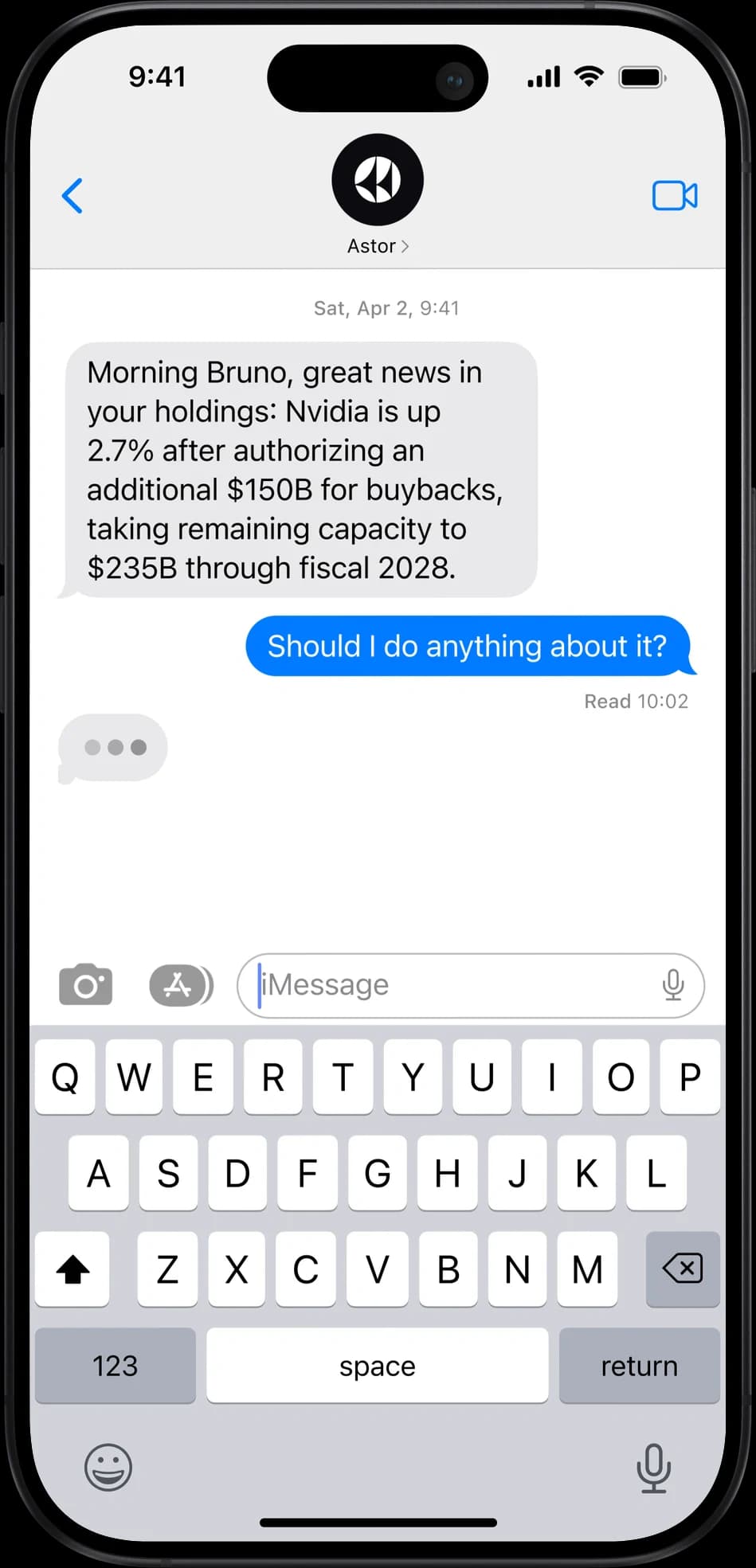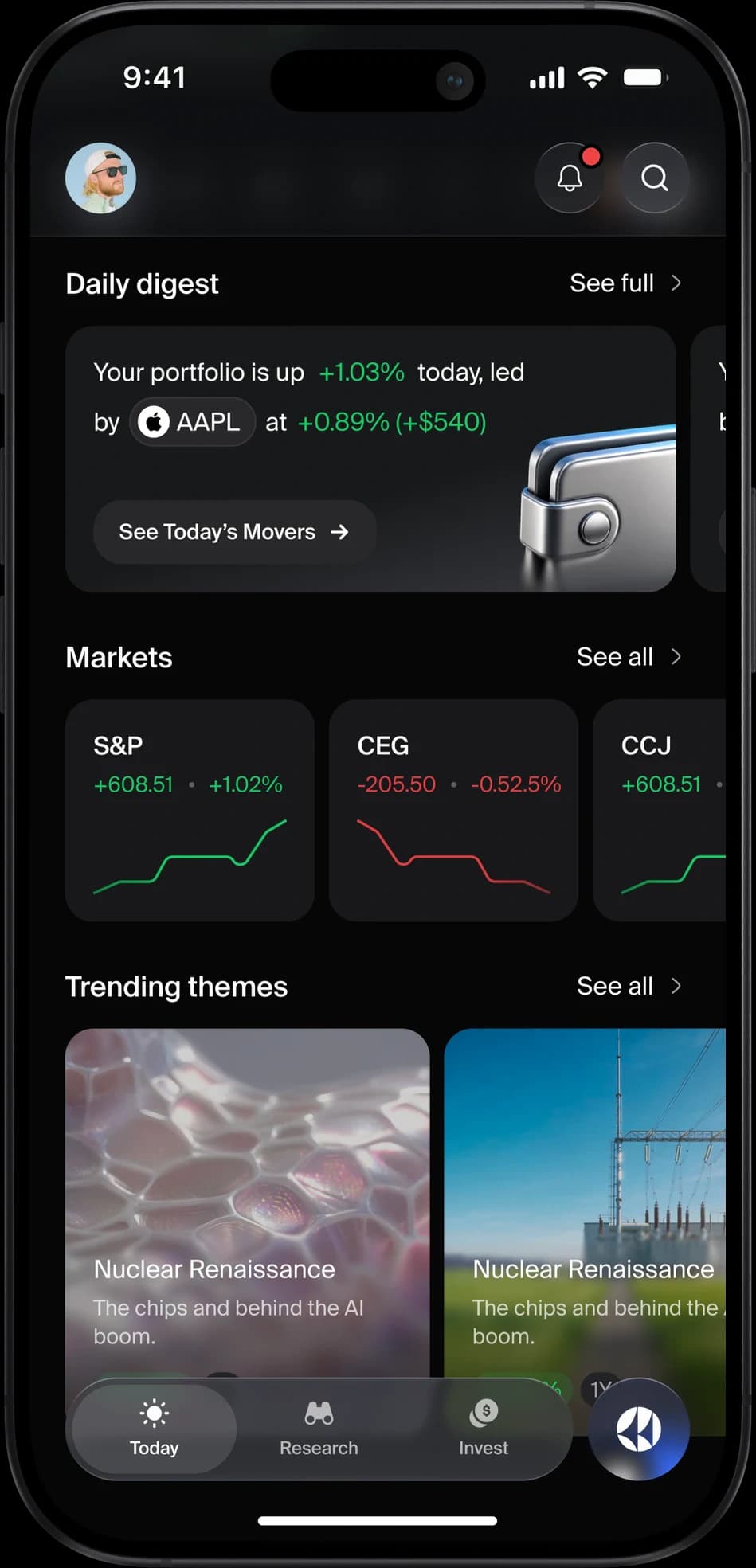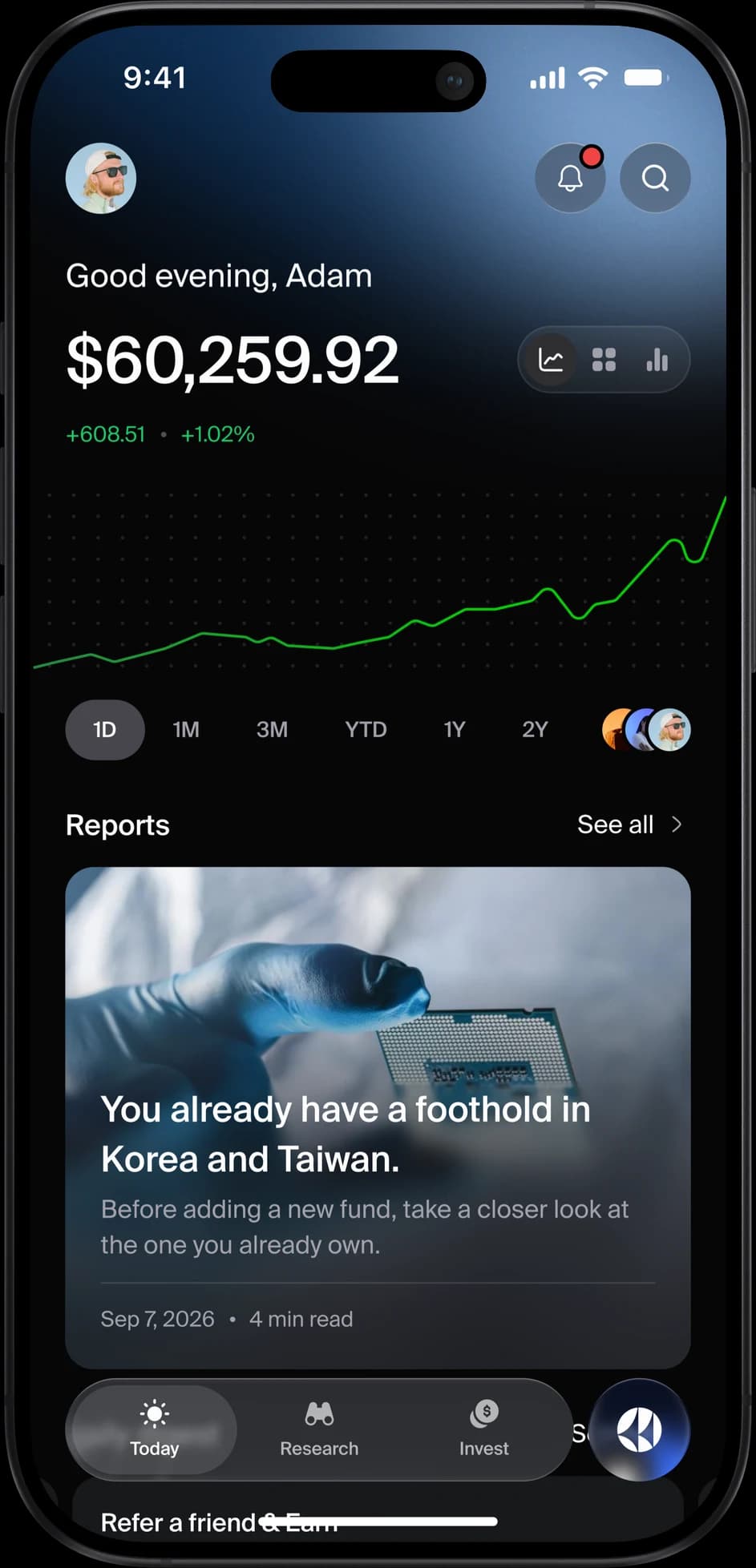
Pick Origin if you want one app for your whole financial life, and pick Astor if you mainly invest and want an agent watching what you own. Astor is a personal investing agent on iPhone and in iMessage that connects to the accounts you already have, follows every position, and texts you when something matters, while you make every decision.
Origin is an all-in-one money app. It combines budgeting, spending, net worth, forecasting, investing and estate planning tools with an AI Advisor that looks across all of it. Both products come from SEC-registered investment advisers, so the real difference is scope. Everything below is as of October 2026.
What’s the difference between Astor and Origin?
Origin is built to be the one place you manage money. You connect your bank, card, loan and investment accounts through Plaid, MX or Finicity, and Origin gives you a budget, a spending view, your net worth and a forecasting tool for big decisions like buying a home or retiring earlier. It also offers its own products, including automated investing, themed stock bundles, a cash account and a basic will, and you can invite a partner at no extra cost.
Origin’s AI Advisor sits on top of that data. You can ask it questions in plain English, model “what if” scenarios and get personalized guidance. It also works proactively, running what Origin calls expert-built checks across spending, savings, investments, retirement, credit, protection, housing, education and estate planning. The results show up as a Financial Health Score and a prioritized list of Actions, each with the reasoning behind it. If you want a person, Origin also sells financial planning sessions with its own planners as a premium service.
Astor goes narrower and deeper. It’s a personal investing agent that connects to your brokerage, retirement and crypto accounts, learns what you own, and watches the market for what matters to your portfolio. When something crosses a line you care about, it texts you what happened, why it matters to you and what you could do. You can text it back in iMessage, check At a glance for two lines on what moved your money today, or set scheduled alerts for things like a check-in after a company you own reports earnings.
Put simply, Origin looks across your whole financial picture, and Astor looks closely at what you own.
How do Astor and Origin compare?
| Astor | Origin | |
|---|---|---|
| What it is | Personal investing agent | All-in-one money app with an AI Advisor |
| Price (as of Oct 2026) | Free to start. Pro $19/month or $10/month billed yearly. Max $29/month or $19/month billed yearly | $99/year. Limited-time $1 first year for new users |
| Fee model | Flat subscription, never a percentage of your assets | Flat membership. Origin says it charges no management, platform or trading fees on its investment accounts |
| Works with accounts you already have | Yes, through Plaid (brokerage, retirement, crypto) | Yes, through Plaid, MX or Finicity (banks, cards, loans, investments) |
| Watches and alerts you | Follows each position and texts you when earnings, filings or headlines matter to you | Proactive Actions from checks across spending, savings, investments, credit and more |
| Budgeting and spending | No | Yes |
| Who places trades | You. Text to Trade orders execute in your own Robinhood agentic account after you approve each one | You act on AI Advisor’s advice yourself. In an Origin automated investing account, Origin invests according to the strategy you pick |
| Regulation | Gaus, Inc. DBA Astor, SEC-registered investment adviser, CRD #338424 | Origin Investment Advisory LLC, SEC-registered investment adviser, CRD #305353 |
| Platforms | iPhone and iMessage | iPhone, Android, web and Mac |
| Best for | People who invest and want an agent watching what they own | People who want one app for their whole financial life |
Which is cheaper?
Origin’s annual plan is $99 a year, and as of October 2026 new users can get the first year for $1 as a limited-time offer. Paying yearly also gets you a 30% discount on Origin’s premium services, like financial planning sessions and full estate plans. Origin says its investment accounts carry no management, platform or trading fees from Origin, though small regulatory fees and some custodian fees can apply.
Astor has a free plan with no card required, which includes one custom alert. Pro is $19 a month, or $10 a month billed yearly ($120 a year). Max is $29 a month, or $19 a month billed yearly ($228 a year). You can cancel either anytime.
So if you compare paid plans billed yearly, Origin’s $99 is a little less than Astor Pro’s $120, and it covers far more ground. Neither one charges a percentage of your assets for its advice. Our guide to what an AI financial advisor costs goes deeper.
Which one keeps a closer eye on your investments?
Origin’s proactive checks are wide. They span spending, savings, investments, retirement, credit, protection, housing, education and estate planning, and they surface as Actions you can mark done, dismiss or add context to. That’s useful if your question is whether your money is in good shape overall.
Astor’s watching is narrow on purpose. It follows every position you own and the earnings dates, filings and headlines that touch them, plus themes you care about, like AI infrastructure or nuclear power. When something crosses a line you care about, it texts you right away, and it stays quiet when nothing matters. Every alert links to the reasoning and sources behind it, so you can check the work before you decide anything. More on how that works in stock alerts for news on stocks you own.
If what you want to know is whether your budget is on track and you’re saving enough, Origin is built for that. If it’s what just happened to a company you own and whether it matters to you, that’s Astor’s job.
How are they regulated?
Both are backed by SEC-registered investment advisers, which you can confirm on the SEC’s Investment Adviser Public Disclosure site. Origin’s advisory services are offered through Origin Investment Advisory LLC (CRD #305353), a subsidiary of Blend Financial, Inc., which does business as Origin. Astor is Gaus, Inc. DBA Astor (CRD #338424). As registered advisers, both owe their advisory clients a fiduciary duty, and Astor’s recommendations are personalized investment advice.
They also describe the AI in similar terms. Origin says its AI Advisor’s advice is non-discretionary, that you have to complete a suitability questionnaire before getting personalized advice, and that its recommendations can contain errors or “model hallucinations.” Astor’s AI can be wrong too, which is why it shows its sources and you make every call.
Registration isn’t an endorsement from the SEC, and it doesn’t mean either AI is right. Our guide to which AI investing apps are SEC-registered shows how to look any firm up yourself.
When is Origin the better choice?
We’d point you to Origin if:
- You want budgeting, spending, net worth and investing in one app, rather than an investing tool on its own.
- You’re planning a big life decision and want to forecast it, like buying a home or retiring earlier.
- You’d like the option of booking sessions with a human planner.
- You manage money with a partner and want shared access.
- You want an automated portfolio that Origin invests for you.
- You use Android, the web or a Mac. Astor is iPhone and iMessage only.
Why Astor
Astor is the better fit if you already invest, your money is spread across a few places, and what you’re missing is something that knows what you own and tells you when it matters. It connects to the brokerage, retirement and crypto accounts you already have at most major US institutions (Robinhood, Schwab and Coinbase, for example). It can see your holdings but can’t move money, and you don’t transfer anything to Astor.
From there it does the research and the watching. It texts you when an earnings report, a filing or a headline touches a position, explains why it matters to you, and suggests what you could do. You can ask follow-up questions about your actual holdings in the same thread. With Text to Trade, launching in October 2026, you can describe an idea in a sentence, and Astor helps you build the strategy and size it against what you already own. You review and approve every trade, and the order executes in your own Robinhood agentic account.
Astor doesn’t do budgeting, tax filing or estate planning, and it doesn’t hold your money or run a managed portfolio. If you want budgeting, financial planning or an automated portfolio, Origin is the better tool. Nothing stops you from using both, either, with Origin for the household budget and Astor for the portfolio.
Frequently asked questions
Is Origin an SEC-registered investment adviser?
Yes. Origin’s advisory services are offered through Origin Investment Advisory LLC, which the SEC’s Investment Adviser Public Disclosure site lists as SEC-registered under CRD #305353. Registration means the firm owes clients a fiduciary duty and files public disclosures. It doesn’t mean the SEC endorses the firm or its AI.
Is Astor an SEC-registered investment adviser?
Yes. Astor is Gaus, Inc. DBA Astor, an SEC-registered investment adviser with CRD #338424. Its recommendations are personalized investment advice, and it owes clients a fiduciary duty. You can look it up on adviserinfo.sec.gov.
Does Astor do budgeting like Origin?
No. Astor focuses on investments and doesn’t do budgeting, spending tracking, tax filing or estate planning. If you want those in one app, Origin is designed for it.
Does Astor hold my money?
No. Astor connects to your existing accounts and can’t move money in them. With Text to Trade, orders execute in your own Robinhood agentic account, only after you approve each trade, and the agent can only use the money you set aside for it. Origin, by contrast, offers its own investment and cash accounts if you choose to open them.
Which is cheaper, Astor or Origin?
As of October 2026, Origin costs $99 a year, with a limited-time $1 first year for new users. Astor is free to start, and Pro costs $120 a year billed yearly or $19 a month. Neither charges a percentage of your assets for advice.
Can I use Astor on Android?
Not yet. Astor is available on iPhone and in iMessage, in the US only. Origin has apps for iPhone, Android and Mac, plus a web app.
Sources
- Origin Support: How much does Origin cost?, accessed Oct 12, 2026
- Origin: Home page and footer disclosures, accessed Oct 12, 2026
- Origin Support: What is the AI Advisor?, accessed Oct 12, 2026
- Origin Support: What are Actions in AI Advisor?, accessed Oct 12, 2026
- Origin Support: AI Advisor Disclaimers and Limitations, accessed Oct 12, 2026
- Origin Support: How do I connect my accounts?, accessed Oct 12, 2026
- Origin Support: What options do I have for investing with Origin?, accessed Oct 12, 2026
- Origin Support: You don’t charge fees for investing, so what’s the cost?, accessed Oct 12, 2026
- Origin Support: What type of topics can my Origin Planner help me with?, accessed Oct 12, 2026
- Origin: Introducing the First SEC-Regulated AI Financial Advisor, accessed Oct 12, 2026
- SEC Investment Adviser Public Disclosure: Origin Investment Advisory LLC (CRD #305353), accessed Oct 12, 2026
- SEC Investment Adviser Public Disclosure: Astor (CRD #338424), accessed Oct 12, 2026
Important information
Gaus, Inc. DBA Astor is an SEC-registered investment adviser (CRD #338424). Registration does not imply a certain level of skill or training. Astor provides non-discretionary advice: you make every investment decision. All investing involves risk, including the loss of principal, and past performance does not guarantee future results. Astor uses AI, which can make mistakes. This article is general information, not individualized investment, tax or legal advice. See our disclosures.
About comparisons
Information about other companies comes from their public websites and filings as of October 2026 and may have changed since; check each provider for current details. Comparisons and rankings reflect Astor’s opinion. Other companies’ names and trademarks belong to their owners, and no affiliation or endorsement is implied.
Share