Comparison
Astor vs. Perplexity Finance: research tool or personal investing agent?
 Astor team9 min read

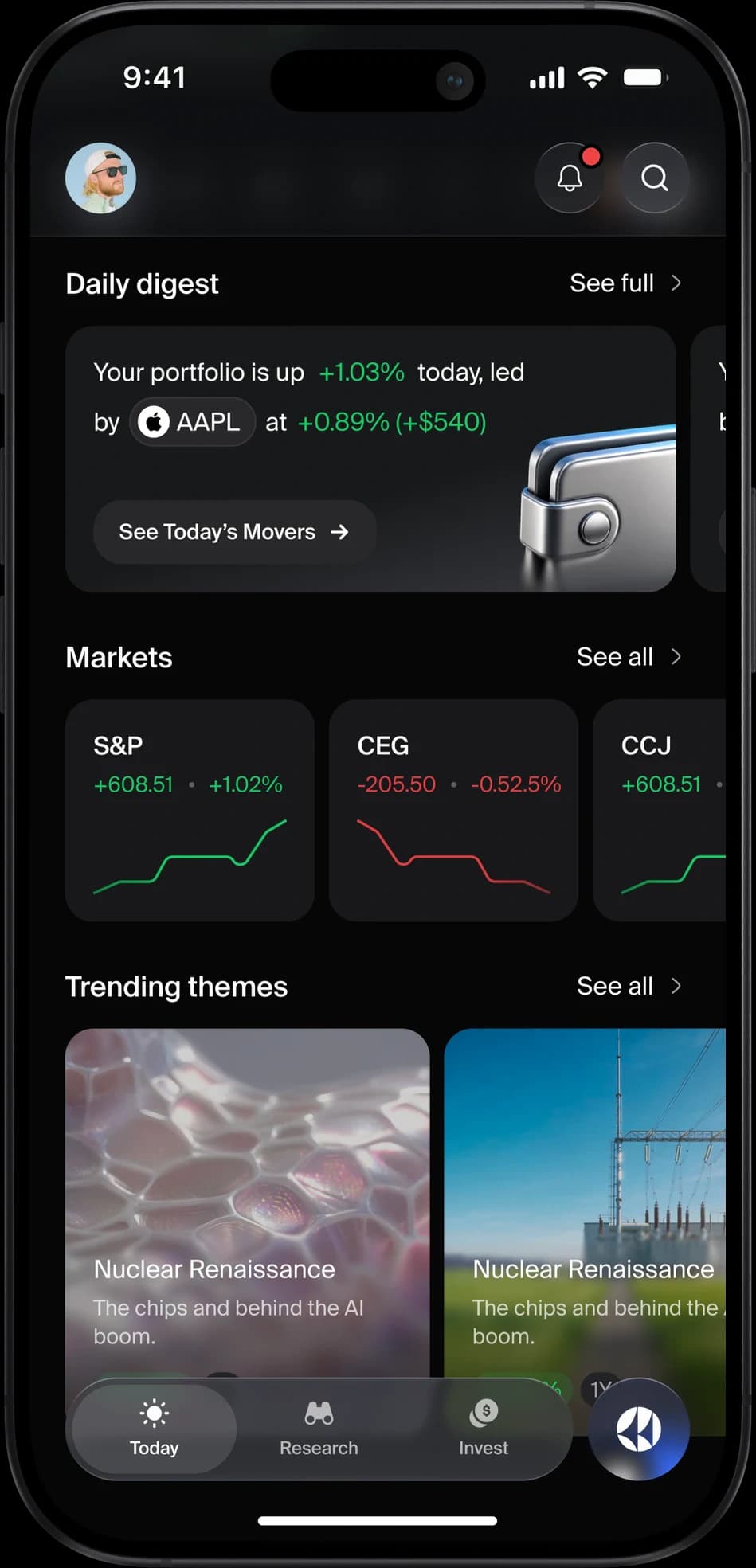
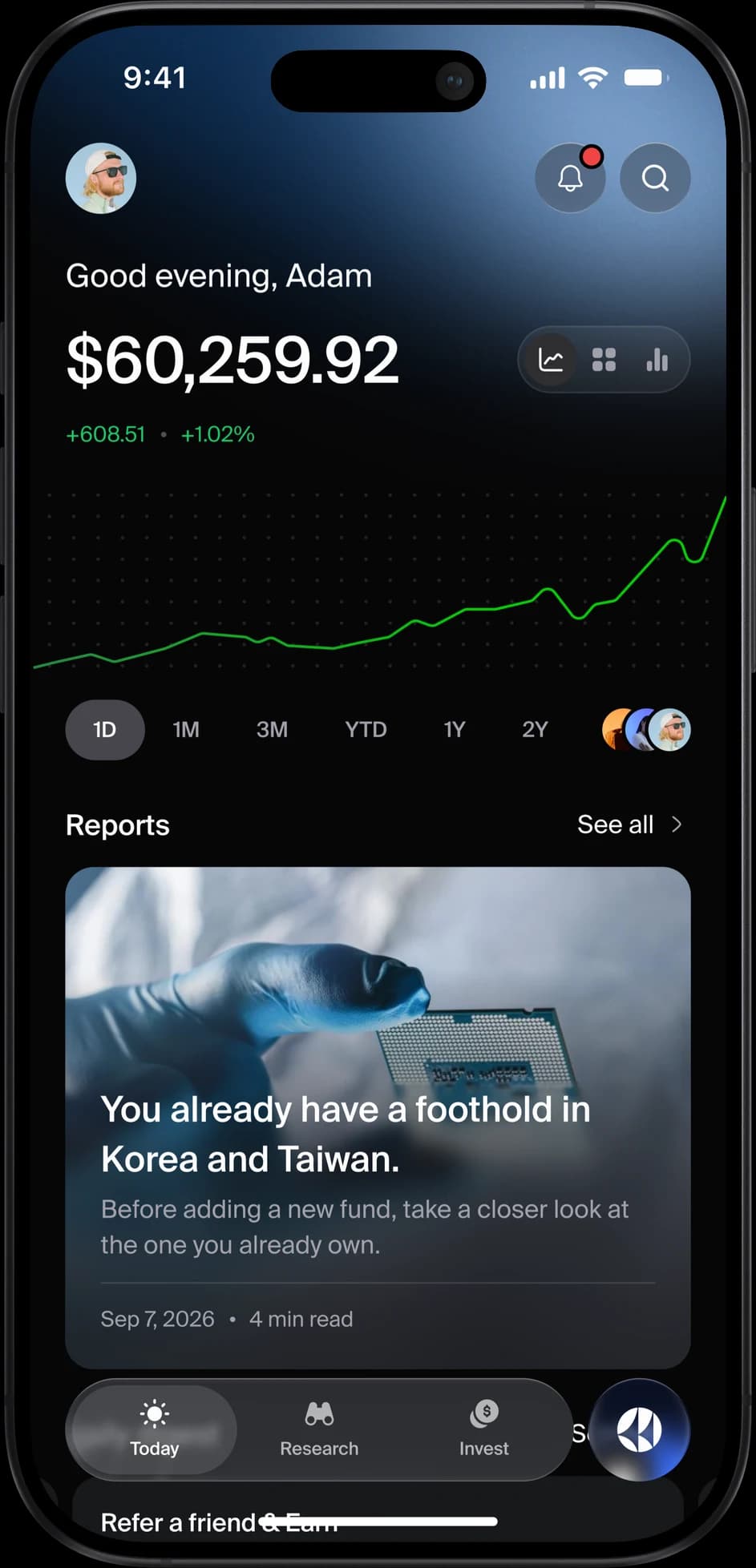
Perplexity Finance is a research tool, and a very good one: you ask about a company, a market or an earnings call and get a fast answer with its sources attached, and since March 2026 it can also read your brokerage holdings through Plaid. Astor is a personal investing agent: an SEC-registered investment adviser on iPhone and in iMessage that connects to the accounts you already have, follows every position you own, and texts you when something matters to your portfolio. If you want to dig into companies, Perplexity is hard to beat, and if you want something that watches what you own and tells you what it means for you, that’s the job Astor is built for.
We make Astor, so this is our view. Every claim about Perplexity below comes from Perplexity’s own pages, checked in October 2026.
What is Perplexity Finance?
Perplexity Finance is the markets section of Perplexity, the AI answer engine. It has pages for US markets, crypto, earnings, a stock screener, watchlists, prediction markets and the trades disclosed by politicians, plus a page for your own portfolio. Its earnings hub includes a calendar and summarizes earnings calls while they’re happening.
The research is the strong part. Perplexity says its finance answers draw on more than 40 tools that pull from SEC filings, FactSet, S&P Global, Nasdaq and other sources, and that you can hover over a cited figure to see where it came from. If you want to compare a company’s margins over the last eight quarters or see what management said on its last call, Perplexity does that quickly and shows its work.
Perplexity also has Computer, an agent that builds things for you, like spreadsheets, dashboards and small apps. Perplexity says advanced Computer features are for Pro and Max subscribers, at $17 and $167 a month billed annually as of October 2026.
Can Perplexity Finance see your brokerage account?
Yes. In March 2026 Perplexity let users in the US and Canada connect brokerage accounts through Plaid, and in April it added bank accounts, credit cards and loans. Perplexity says the Plaid integration provides read-only access. When account linking launched, it was available on desktop to all signed-in users in the US and Canada, with mobile and other countries to follow. Perplexity said standard (free) users could link a portfolio, use the basic Portfolio page and ask questions about their finances.
Once your accounts are linked, you can ask Perplexity about your holdings, or ask Computer to build something on top of them, like a net worth dashboard or a retirement readiness tracker. Perplexity says dashboards built in Computer can keep monitoring your finances in the background.
That narrows the gap between a research tool and a portfolio tool. What’s left is who decides what to watch, and whether the answer comes with an adviser’s duty.
Does Perplexity Finance watch your stocks and alert you?
It alerts you on terms you set. Perplexity’s price alerts fire when a stock hits a target price or moves past an intraday threshold you choose, then run a query for you and send an email or push notification. Its Tasks feature runs scheduled searches and daily summaries, and Computer can run scheduled tasks of its own. All of these are useful, and all of them depend on you deciding ahead of time what to watch and when.
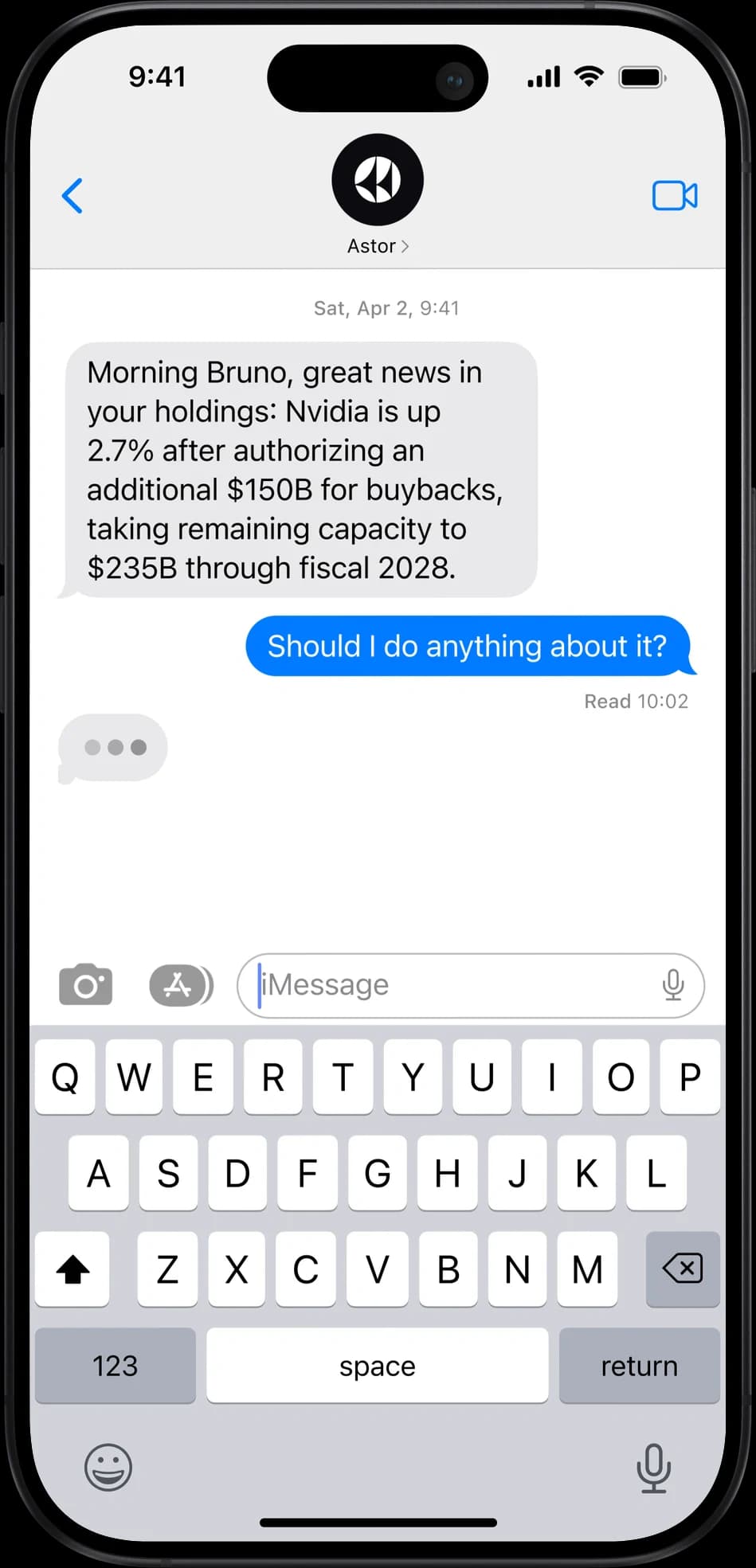
Astor starts from your portfolio instead. It follows every position you own, along with the earnings dates, filings and headlines that touch them and the themes you care about, and texts you in iMessage when something crosses a line you care about. Each alert says what happened, why it matters to you and what you could do, and links to the reasoning and sources behind it. When nothing matters, it stays quiet, and you get a daily brief before the open and a recap after the close. There’s more in at a glance and stock alerts for news on stocks you own.
Does Perplexity Finance give investment advice?
No, by its own description. The Perplexity Finance page says its data is provided for informational purposes only and isn’t intended as financial or investment advice. That’s an honest description of a research tool, and it means the call on what to do with your portfolio stays entirely with you.
Astor is an SEC-registered investment adviser (CRD #338424), so its recommendations are personalized investment advice and it owes clients a fiduciary duty. The SEC’s Investor.gov describes that duty as being required to act in your best interest and not put the adviser’s interests ahead of yours. It does the research and the watching, and you make every decision. Registration isn’t an endorsement by the SEC, and you can check any adviser’s record on the SEC’s Investment Adviser Public Disclosure site. We cover this in more depth in SEC-registered AI investment advisers.
Astor vs. Perplexity Finance at a glance
| Astor | Perplexity Finance | |
|---|---|---|
| What it is | A personal investing agent | AI market research inside Perplexity |
| Price (October 2026) | Free to start. Pro $19/month ($10/month billed yearly). Max $29/month ($19/month billed yearly) | Free tier. Pro $17/month and Max $167/month, billed annually |
| Fee model | Flat subscription, never a percentage of your assets | Flat subscription |
| Sees your holdings | Yes, through Plaid | Yes, through Plaid in the US and Canada, read-only according to Perplexity |
| Watches your holdings and alerts you | Follows every position by default and texts you when something crosses a line you care about | Price alerts and scheduled tasks you set up, by email or push |
| Research | Live prices, news and filings about what you own, with sources | Broad market research, earnings hub and screener, with cited sources |
| Who places trades | You. Astor can’t trade in your connected accounts, and Text to Trade executes only in your own Robinhood agentic account after you approve each trade | You, at your broker. Perplexity’s portfolio connection is read-only |
| Regulation | SEC-registered investment adviser with a fiduciary duty | Says its finance data isn’t investment advice |
| Platforms | iPhone and iMessage, US only | Web and apps, with account linking launched on desktop in the US and Canada |
| Best for | Investors who want something watching what they own | Researching companies and markets, and building custom tools |
When Perplexity Finance is the better choice
If your main job is research, Perplexity is the better tool. Following earnings calls as they happen, screening for ideas and checking figures against their sources is what it does best, and much of it is free.
It’s also the better choice if you want to build your own tools. Computer can turn your linked accounts into a custom dashboard, a spreadsheet model or a debt payoff plan. Astor gives you its own views of your portfolio, but it doesn’t build custom spreadsheets or apps.
Perplexity covers more of your financial life, too. It links bank accounts, credit cards and loans alongside your brokerage, so it can help with spending and net worth. Astor doesn’t do budgeting, tax filing or estate planning.
And there are practical reasons. Astor is iPhone and iMessage only, and US only. If you live in Canada, use Android, or want to work in a browser, Perplexity is available to you and Astor isn’t.
Why Astor is the better fit for your portfolio
In our view, judged on the criteria in the table, an agent that starts from your portfolio is the better fit for help with the investments you already own.
Astor knows your actual holdings across brokerage, retirement and crypto accounts, through connections to most major US institutions, including Robinhood, Schwab and Coinbase. It doesn’t wait for you to set an alert. It texts you when something matters, explains it in terms of your portfolio, and answers follow-up questions in the same thread, using live prices, news and filings and linking to its sources. The AI can be wrong, which is why it shows its sources and you make the call.
Astor is also a registered investment adviser that owes clients a fiduciary duty. It never trades or moves money in your connected accounts, and it charges a flat subscription instead of a percentage of your assets. If you want to act on an idea, Text to Trade, launching in October 2026, lets you describe it in a sentence, review a proposed basket with the reasons each company made the cut, and approve each trade before it executes in your own Robinhood agentic account.
The two work well side by side: Perplexity to research a company, Astor to watch the portfolio you already have. You can see how Astor works, compare it with other tools in the best AI investing apps, or read what a personal investing agent is.
Frequently asked questions
Is Perplexity Finance free?
Much of it is. Perplexity Finance’s market pages are free to browse, and Perplexity said at launch that standard (free) users could link a portfolio and use the basic Portfolio page. Advanced Computer features are for Pro and Max subscribers, which cost $17 and $167 a month billed annually as of October 2026.
Can Perplexity Finance see my brokerage account?
Yes, if you’re in the US or Canada and you link it through Plaid. Perplexity says the connection is read-only, so it can see your holdings but can’t trade or move money. You can then ask questions about your portfolio or have Computer build dashboards on top of it.
Is Perplexity Finance a financial adviser?
Perplexity says its finance data is for informational purposes only and isn’t intended as investment advice. Astor is an SEC-registered investment adviser, so its recommendations are personalized investment advice and it owes clients a fiduciary duty.
What’s a good Perplexity Finance alternative for watching my portfolio?
If you want research, Perplexity is already one of the strongest options, in our view. If you want something that watches the portfolio you already have and gives you personalized advice, look at a personal investing agent like Astor, which connects to your accounts, texts you when something matters, and leaves every decision to you. Our guide to AI investing apps that work with your brokerage covers more options.
Does Astor trade for me?
No. Astor can see the holdings in your connected accounts, but it can’t move money or place trades in them. With Text to Trade, you approve every trade, the order executes in your own Robinhood agentic account, and the agent can only use the money you set aside for it.
Sources
- Perplexity: Perplexity Finance, accessed Oct 12, 2026
- Perplexity blog: Computer is now your personal CFO (April 9, 2026), accessed Oct 12, 2026
- Perplexity changelog: Computer for Pro subscribers, Computer for Slack (March 13, 2026), accessed Oct 12, 2026
- Perplexity changelog: Price alerts, Earnings hub, and Morningstar research, accessed Oct 12, 2026
- Perplexity Help Center: Delete scheduled tasks, Perplexity Tasks vs. Computer, accessed Oct 12, 2026
- Perplexity: Pro and Max plans, accessed Oct 12, 2026
- Investor.gov (SEC): Investment Advisers, accessed Oct 12, 2026
- SEC Investment Adviser Public Disclosure: Astor (CRD 338424), accessed Oct 12, 2026
Important information
Gaus, Inc. DBA Astor is an SEC-registered investment adviser (CRD #338424). Registration does not imply a certain level of skill or training. Astor provides non-discretionary advice: you make every investment decision. All investing involves risk, including the loss of principal, and past performance does not guarantee future results. Astor uses AI, which can make mistakes. This article is general information, not individualized investment, tax or legal advice. See our disclosures.
About comparisons
Information about other companies comes from their public websites and filings as of October 2026 and may have changed since; check each provider for current details. Comparisons and rankings reflect Astor’s opinion. Other companies’ names and trademarks belong to their owners, and no affiliation or endorsement is implied.
Share