Guide
Robo-advisor vs. AI investing agent vs. financial advisor: what’s the difference?
 Astor team9 min read

A robo-advisor runs an automated portfolio for you, an AI investing agent like Astor watches the investments you already own and helps you decide what to do, and a financial advisor is a person who advises you across your whole financial life. The differences that matter most are who makes the decisions, how much of your life the help covers, and how you pay for it.
Astor makes one of these, a personal investing agent, so read this with that in mind. We’ve described all three the way their providers and independent research describe them, with prices as of October 2026.
What does a robo-advisor do?
A robo-advisor is software that manages a portfolio for you. You answer questions about your goals and how much risk you can take, it recommends a diversified mix of low-cost ETFs, and you give it discretionary authority to buy and sell inside the account. From then on it keeps the portfolio near its target mix, and many offer tax-loss harvesting in taxable accounts.
Prices for the automated tiers, as of October 2026:
- Wealthfront charges 0.25% a year, with a $500 minimum.
- Betterment charges $5 a month on smaller balances and 0.25% a year once you have $24,000 or set up $200 a month in recurring deposits.
- Fidelity Go charges nothing under $25,000 and 0.35% a year from $25,000, which also adds one-on-one coaching calls.
- Schwab Intelligent Portfolios charges no advisory fee and needs $5,000 to start. Schwab says it can do that partly because of the revenue Schwab Bank earns on the cash the portfolios hold.
Fund expense ratios are separate from these fees. The strengths are real. Robo-advisors cost little, and software sticks to the plan in a bad week. The trade-off is that they manage the money you move into their accounts, so the stocks you pick yourself somewhere else aren’t part of the job.
What does an AI investing agent do?
An AI investing agent, as we use the term, works with the accounts you already have. It doesn’t hold your money or manage a portfolio, and it comes to you when something matters so you can decide what to do.
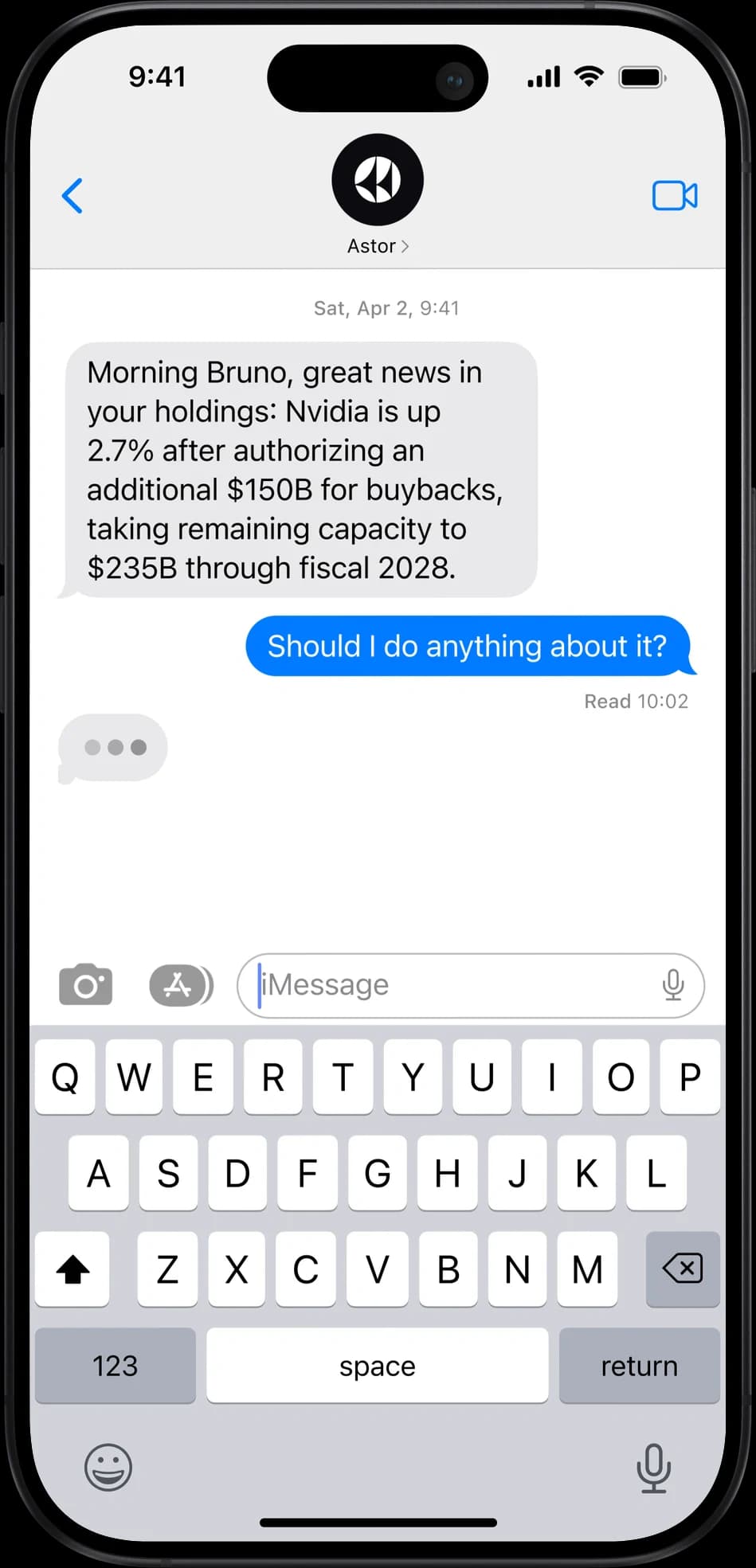
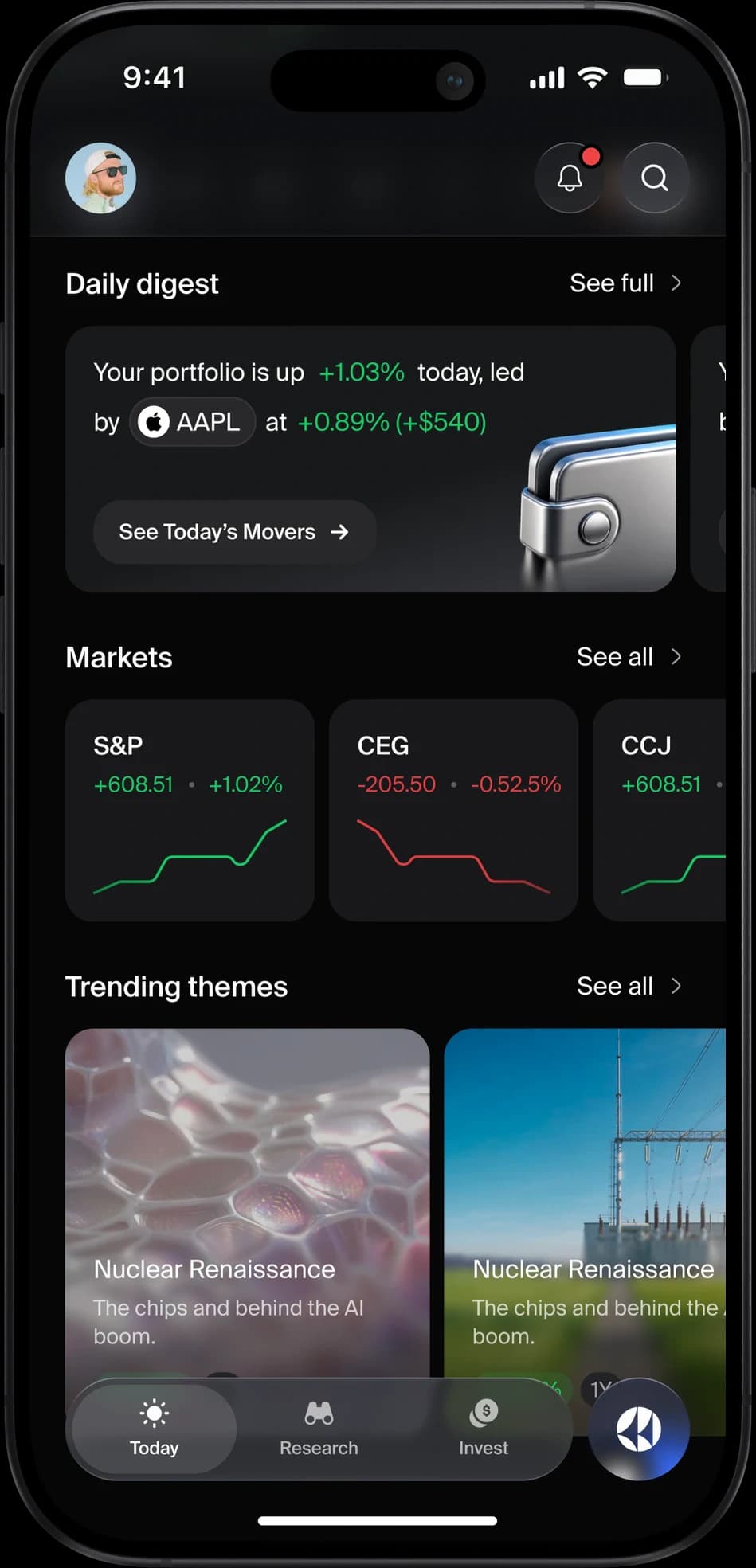
Astor is a personal investing agent on iPhone and in iMessage. It connects to brokerage, retirement and crypto accounts at most major US institutions, like Robinhood, Schwab and Coinbase, through Plaid. It follows every position you own, plus the earnings dates, filings and headlines that touch them, and texts you what happened, why it matters to you and what you could do. You can ask it anything about your actual holdings, set scheduled alerts, and, with Text to Trade launching in October 2026, turn an idea into a proposed basket of companies that only executes in your own Robinhood agentic account after you approve each trade.
The limits are worth saying plainly. An agent doesn’t build a financial plan, and Astor doesn’t do budgeting, tax filing or estate planning. The AI can be wrong, which is why Astor shows the reasoning and sources behind every alert and you make the call. Not every AI investing tool is a registered adviser, either, so check before you rely on one. We compare a few in SEC-registered AI investment advisers, and what is a personal investing agent goes deeper on the category.
What does a financial advisor do?
A good financial advisor is a person who gets to know your whole situation and stays with you over years. Many cover far more than investments, like retirement income, taxes, insurance, estate planning, equity compensation or selling a business, and they can coordinate those pieces with your accountant and attorney. For people with complex finances, or who simply want a dedicated person to call, that’s hard to replace.
Advisors charge in a few ways, according to Kitces Research, which surveys financial advisors:
- A percentage of assets. This is the most common model. In Kitces’s 2024 data, 92% of advisors used asset-based fees in some way and 86% of firms used them as their main way of charging. The median for an advisor who charges only an asset-based fee is about 1% for a client with $1 million, or $10,000 a year, and rates usually step down on larger portfolios. That fee typically pays for more than investing, since advisors attribute about 41% of it, on average, to planning and other services.
- Hourly. Advisors who bill by the hour charge about $300 an hour on average, and an average of $2,886 for most financial plans.
- A flat yearly fee. Subscription or retainer pricing had a median of $4,500 a year in 2024, up from $3,000 in 2022.
Many advisors who charge a percentage of assets also set a minimum. About two-thirds of those firms have one, roughly a third of them at $1 million or more, though most say they waive it at least occasionally. There are also hybrids between a robo-advisor and a person. Betterment Premium adds advice from its financial consultants for 0.65% a year with a $100,000 minimum, and Vanguard Personal Advisor Select pairs you with a dedicated CFP professional for up to 0.30% a year with a $500,000 minimum.
You’ll see both spellings, “adviser” and “advisor.” Adviser is the term in SEC rules, advisor is the everyday spelling, and here they mean the same thing.
How do the three compare?
| Robo-advisor | AI investing agent (Astor) | Financial advisor | |
|---|---|---|---|
| Who makes the decisions | The robo-advisor, under discretion you grant | You, with research and alerts from Astor | Depends on the agreement. Many manage with discretion, and some only advise |
| What it covers | A diversified portfolio inside its own accounts | Every holding in the accounts you connect | Your whole financial picture, often including taxes, retirement and estate |
| Typical cost (October 2026) | 0.35% of assets a year or less for automated tiers (Betterment: $5/month on small balances) | Free, or $120 to $228 a year billed yearly | Often about 1% of assets, about $300 an hour, or a $4,500 median yearly flat fee |
| Minimums | $0 to $5,000 for the examples above | Nothing to deposit | Common for asset-based firms, often $500,000 or more |
| Where your money is | In an account at the robo-advisor’s broker | Stays in your own accounts | Usually at a third-party custodian |
| How you interact | An app and website | iPhone and iMessage | Meetings, calls and email with a person |
| Best for | Hands-off investors who want a diversified portfolio | People who pick their own investments and want help keeping up | People who want a dedicated person and comprehensive planning |
Which one should you choose?
Start with how much you want to decide yourself, then with how complicated your finances are.
Choose a robo-advisor if you’d rather not pick investments and want a diversified portfolio that runs without you. It’s the lowest-effort option, and at small balances one of the cheapest.
Choose an AI investing agent if you already invest on your own and want to stay in charge. It’s built for people who hold individual stocks or ETFs across a few accounts and want to know when something touches them, without moving money or paying a percentage of their assets. You can see how Astor lines up against the robo-advisors in Astor vs. Wealthfront and Astor vs. Betterment.
Choose a financial advisor if your situation has several moving parts, like equity compensation, a business, an inheritance, or planning how to draw down savings in retirement, or if you simply want a dedicated person who knows your whole picture. That kind of judgment and coordination is what a good advisor is for, and it’s not something Astor does.
Combine them if that fits better. A flat-fee or hourly planner can build the plan, a robo-advisor can run a hands-off core, and an agent like Astor can watch the accounts you manage yourself.
Why we built Astor as an agent
The way we saw it when we started Astor, people who invest on their own had two main kinds of help. A robo-advisor would run a portfolio for them, and a financial advisor would plan and invest alongside them, usually for a percentage of assets and often with a minimum. If you wanted to keep making your own picks, you were mostly doing the research and the watching yourself.
Astor is for that person. It watches everything you own across the accounts you connect and texts you what changed and why it matters, with the sources attached, for a flat subscription that doesn’t grow with your balance. Because Astor is an SEC-registered investment adviser, its recommendations are personalized investment advice and it owes clients a fiduciary duty. It never trades or rebalances for you. It does the research and the watching, and you make every decision.
Frequently asked questions
Is a robo-advisor a financial advisor?
Robo-advisors like Wealthfront and Betterment are registered with the SEC as investment advisers, so legally they’re advisers. The difference is that software, not a person, builds and manages your portfolio, and the service usually covers that portfolio rather than your whole financial life.
Is an AI investing agent a registered investment adviser?
Some are and some aren’t, so check. Astor is. Gaus, Inc. DBA Astor is an SEC-registered investment adviser (CRD 338424), and the AI is the tool the firm uses to do the work. You can look up any firm on the SEC’s Investment Adviser Public Disclosure site. Registration doesn’t mean the SEC endorses a firm.
How much does a financial advisor cost?
It depends on how they charge. Kitces Research puts the median asset-based fee at about 1% for a $1 million client, or $10,000 a year, with lower rates on larger portfolios. Hourly advisors average about $300 an hour, and flat-fee advisors had a median of $4,500 a year in 2024.
Do I need a financial advisor if I use a robo-advisor or an AI agent?
Not necessarily, since they solve different problems. If you have complex questions about taxes, retirement income, estate planning or a business, a human advisor is the better fit for those, and you can use one alongside software.
Are robo-advisors and AI investing agents fiduciaries?
Registered investment advisers owe their clients a fiduciary duty, which the SEC describes as a duty of care and a duty of loyalty. Wealthfront’s and Betterment’s Form CRS both say they have to act in your best interest when acting as your adviser. Astor is an SEC-registered investment adviser and owes clients a fiduciary duty too.
Sources
- Kitces: How Financial Advisors Actually Charge For Their Services, accessed Oct 12, 2026
- Kitces: Improving The Scalability Of Advisory Firm Flat-Fee Models, accessed Oct 12, 2026
- SEC: Commission Interpretation Regarding Standard of Conduct for Investment Advisers (2019), accessed Oct 12, 2026
- Wealthfront: Fees, accessed Oct 12, 2026
- Wealthfront Advisers LLC and Wealthfront Brokerage LLC: Form CRS, July 23, 2026, accessed Oct 12, 2026
- Betterment: Pricing, accessed Oct 12, 2026
- Betterment LLC: Form CRS, July 31, 2026, accessed Oct 12, 2026
- Fidelity: Fidelity Go, accessed Oct 12, 2026
- Charles Schwab: Schwab Intelligent Portfolios, accessed Oct 12, 2026
- Vanguard: Personal Advisor, accessed Oct 12, 2026
- SEC Investment Adviser Public Disclosure: Gaus, Inc. DBA Astor (CRD 338424), accessed Oct 12, 2026
Important information
Gaus, Inc. DBA Astor is an SEC-registered investment adviser (CRD #338424). Registration does not imply a certain level of skill or training. Astor provides non-discretionary advice: you make every investment decision. All investing involves risk, including the loss of principal, and past performance does not guarantee future results. Astor uses AI, which can make mistakes. This article is general information, not individualized investment, tax or legal advice. See our disclosures.
About comparisons
Information about other companies comes from their public websites and filings as of October 2026 and may have changed since; check each provider for current details. Comparisons and rankings reflect Astor’s opinion. Other companies’ names and trademarks belong to their owners, and no affiliation or endorsement is implied.
Share