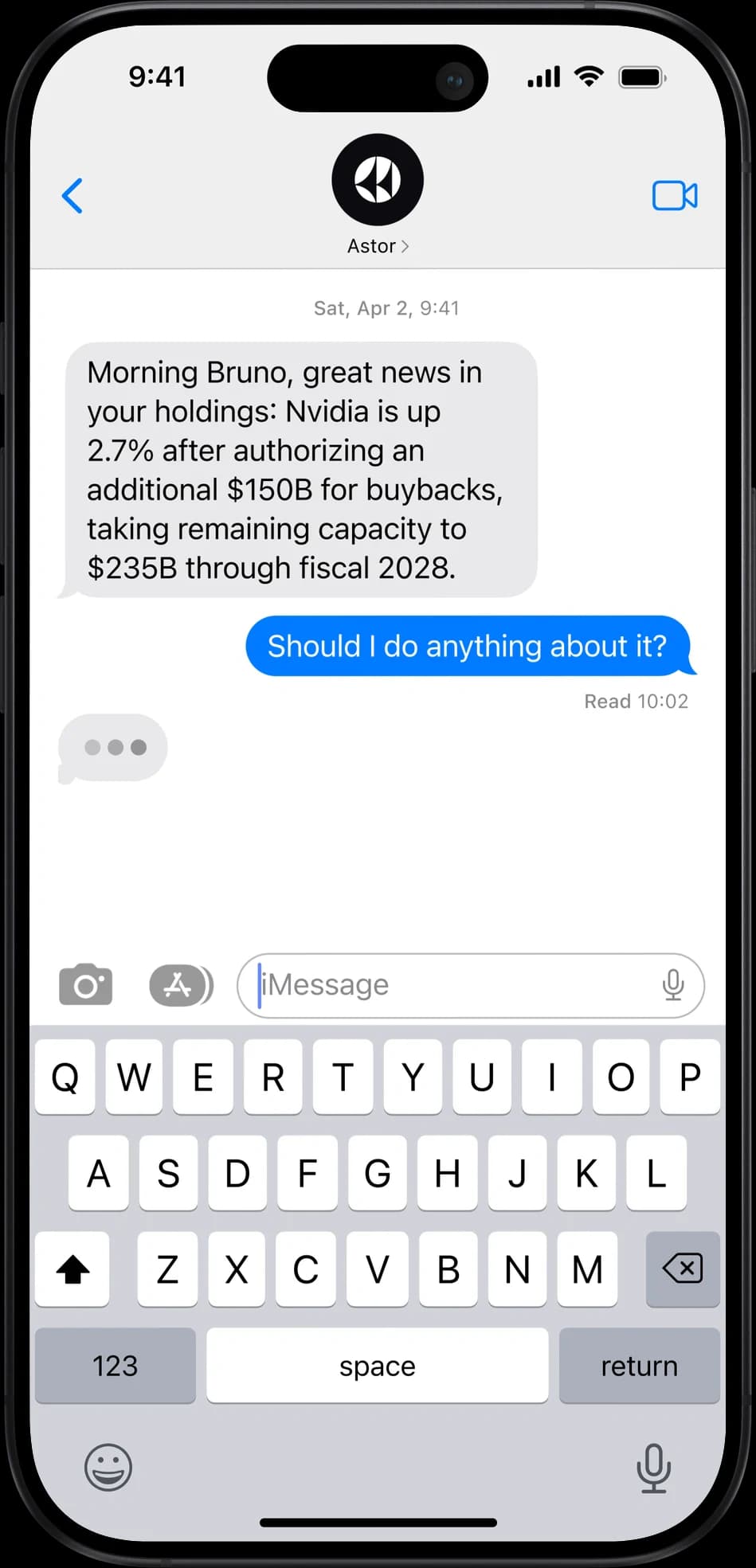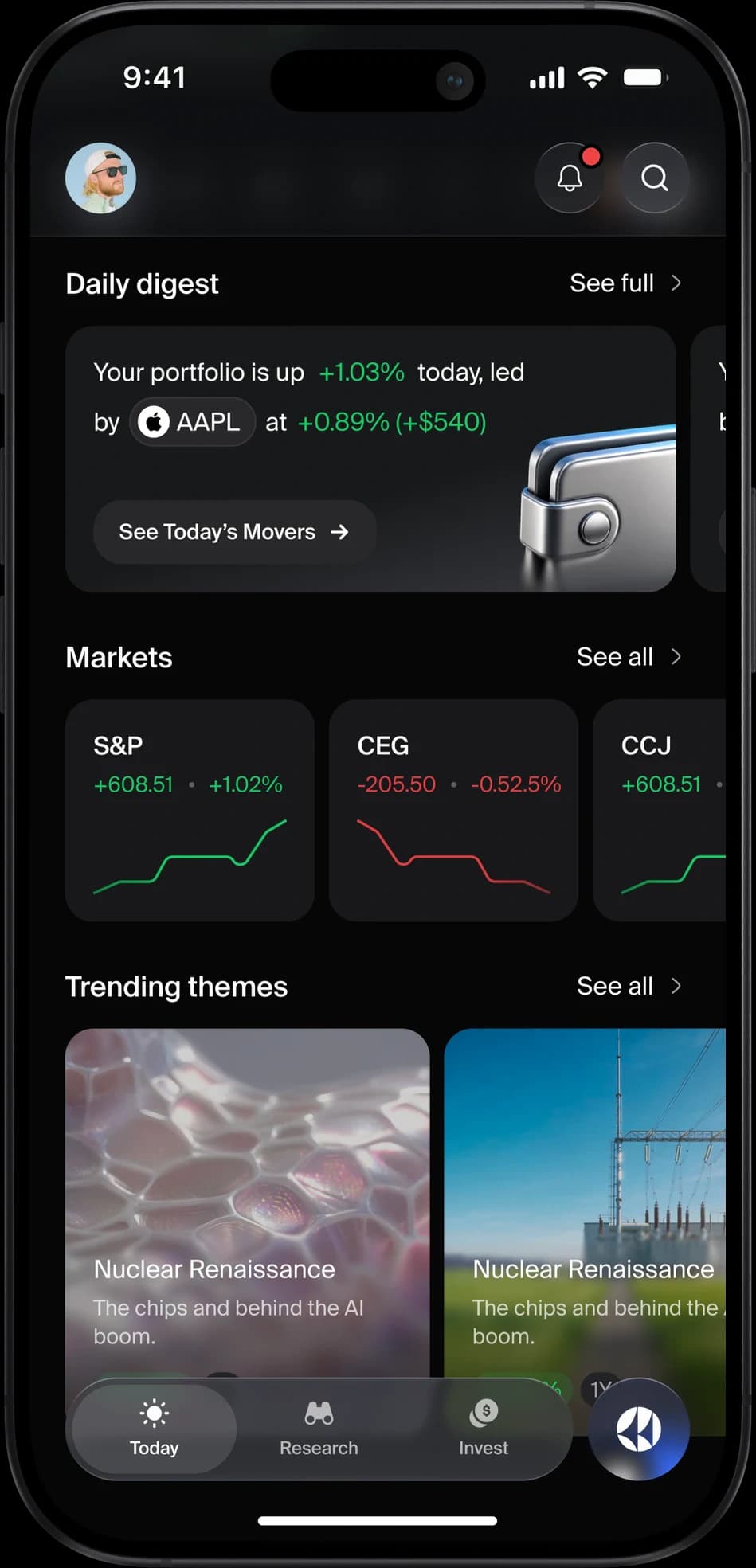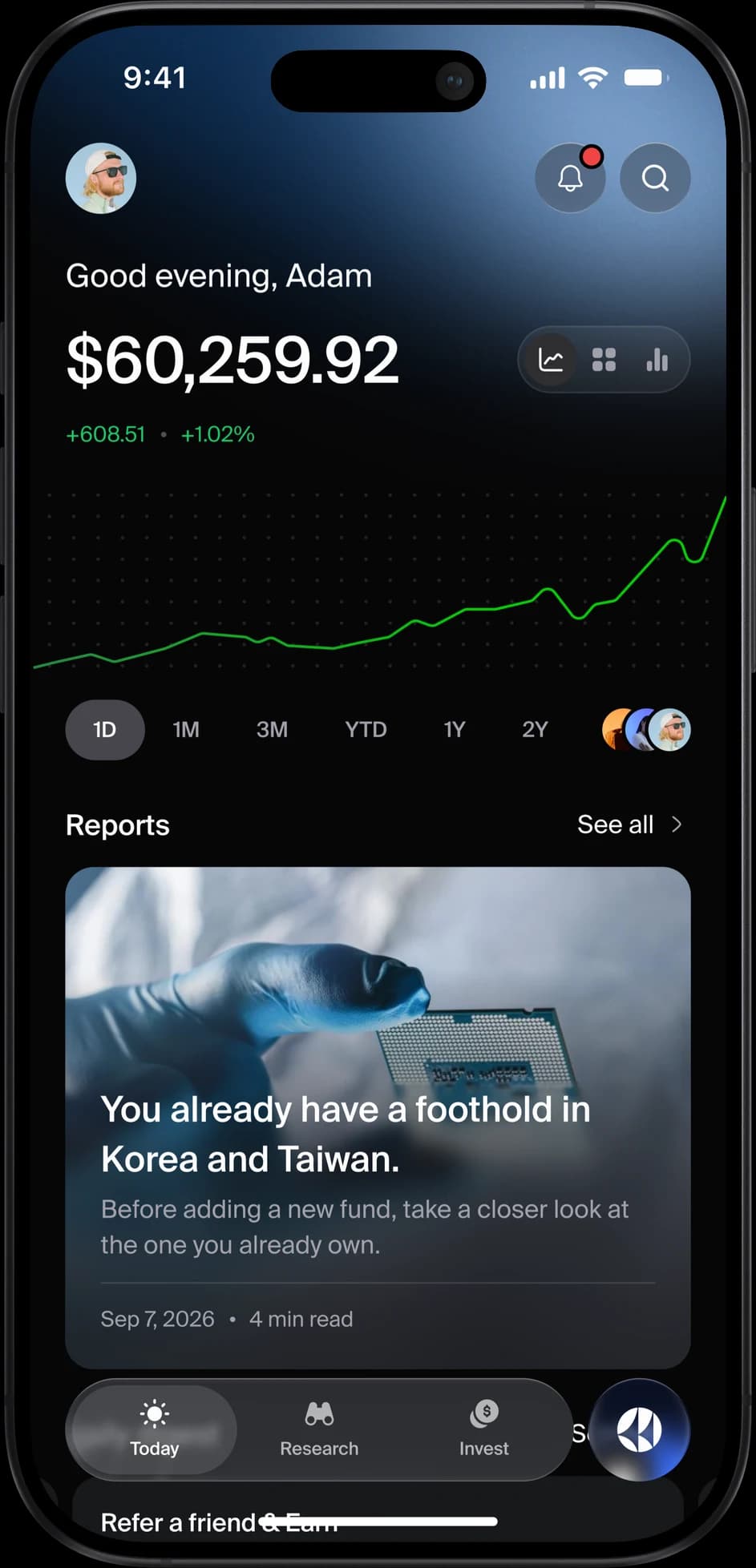
Yes. In the US, ChatGPT can now read your investment accounts through its Finances feature, which links them with Plaid and can walk you through your allocation and the daily moves in your stocks and ETFs. But OpenAI’s own help center says ChatGPT isn’t a fiduciary or a registered investment adviser, and it looks at your portfolio only when you ask or on a set schedule. Astor is a personal investing agent on iPhone and in iMessage: an SEC-registered investment adviser that connects to the accounts you already have, follows every position you own, and texts you when something matters to your portfolio, while you make every decision.
We make Astor, so this is our view, and every claim about ChatGPT below comes from OpenAI’s own pages as of October 2026.
Can ChatGPT see your brokerage account?
Yes, if you’re in the US and you connect it. ChatGPT’s Finances feature links your accounts through Plaid, and once they’re connected ChatGPT can use your balances, transactions, investments and debts to answer questions. OpenAI lists reviewing your portfolio allocation and understanding the daily changes in your stock and ETF holdings among the things it helps with, and the Finances page can show a portfolio breakdown and a market update for your equity holdings. OpenAI also says ChatGPT can’t move money, make trades or change your account settings.
There’s a second route. Some brokerages publish their own plugins for ChatGPT. OpenAI’s page for the Interactive Brokers plugin says you can ask about positions, balances and open orders, and have ChatGPT draft trade instructions that go to your Interactive Brokers account for you to review and approve. ChatGPT never sends those orders to the market itself.
If you don’t connect anything, you can still paste your holdings into a chat. That’s fine for a one-time look, but it’s a snapshot, and it goes stale the next time you trade.
So the old answer, that ChatGPT can’t see your portfolio, is out of date. What matters now is what it does when you’re not asking, and who is responsible for the advice.
Does ChatGPT watch your stocks and alert you?
It can, but you have to set it up. ChatGPT’s scheduled tasks run once or on a repeating schedule, and its monitoring tasks check for changes and send you a notification when something relevant happens. OpenAI says tasks can use your Finances data, for example to send a portfolio update after the market closes, and connecting an account may add a weekly finances update on its own.
The limits matter if you want a watchdog. As of October 2026, Free and Go accounts can have three active tasks, Plus five and Pro 15. Free tasks run at most once a day, and eligible paid plans can run them hourly. Tasks that use your Finances data run on a schedule rather than in response to events, and you decide ahead of time what each one looks for.
Astor works the other way around. When you connect your accounts, it starts following every position you own, along with the earnings dates, filings and headlines that touch them and any themes you care about. When something crosses a line you care about, it texts you right away, and when nothing matters it stays quiet. You also get a daily brief before the open and a recap after the close, and you can still ask Astor to check something on your own schedule, like every morning or before a company reports. We wrote more about this in stock alerts for news on stocks you own and scheduled alerts.
Is ChatGPT a financial adviser?
No, and OpenAI is direct about it. Its Finances help article says ChatGPT isn’t a fiduciary, registered investment adviser or broker-dealer, that its responses are for informational and planning purposes, and that you should consult a qualified professional before making decisions with investment consequences. OpenAI’s Terms of Use say you shouldn’t rely on its output as a substitute for professional advice, and its usage policies prohibit using its services for tailored advice that requires a license without a licensed professional involved.
That isn’t a knock on ChatGPT, which is a general-purpose assistant, but it does change who is accountable for the answer. The SEC’s Investor.gov explains that investment advisers are required to act in your best interest and not put their interests ahead of yours. That duty comes with being a registered adviser, and OpenAI says ChatGPT isn’t one.
Astor is. Gaus, Inc. DBA Astor is an SEC-registered investment adviser (CRD #338424), so its recommendations are personalized investment advice and it owes clients a fiduciary duty. The AI is a tool the firm uses, and the adviser is the firm. Registration doesn’t mean the SEC endorses Astor, and you can look up any adviser yourself on the SEC’s Investment Adviser Public Disclosure site. There’s more on this in SEC-registered AI investment advisers.
Astor vs. ChatGPT at a glance
| Astor | ChatGPT | |
|---|---|---|
| What it is | A personal investing agent | A general-purpose AI assistant with a Finances feature |
| Price (October 2026) | Free to start. Pro $19/month ($10/month billed yearly). Max $29/month ($19/month billed yearly) | Free. Go $8/month, Plus $20/month, Pro from $100/month |
| Fee model | Flat subscription, never a percentage of your assets | Flat subscription |
| Sees your holdings | Yes, through Plaid | Yes in the US, through Plaid (Finances) or a brokerage’s own plugin |
| Watches your holdings and alerts you | Follows every position by default and texts you when something crosses a line you care about | Scheduled and monitoring tasks you create, up to daily on Free and hourly on paid plans |
| Where you talk to it | iMessage and the iPhone app | ChatGPT on the web, iOS and Android |
| Who places trades | You. Astor can’t trade in your connected accounts, and Text to Trade executes only in your own Robinhood agentic account after you approve each trade | You. OpenAI says ChatGPT can’t make trades, and broker plugins can draft orders for you to approve |
| Regulation | SEC-registered investment adviser with a fiduciary duty | OpenAI says ChatGPT isn’t a fiduciary or a registered investment adviser |
| Platforms | iPhone and iMessage, US only | Web, iOS and Android, with Finances in the US only |
| Best for | Investors who want something watching what they own | Learning, writing, everyday money questions and budgeting |
When ChatGPT is the better choice
If you’re learning how investing works, like what a Roth IRA is, why bond prices fall when rates rise, or how to read a 10-K, ChatGPT is excellent, and you don’t need to connect anything to get a good answer.
It’s also the better tool for the rest of your money. ChatGPT’s Finances feature covers spending, bills, subscriptions, net worth and your Experian credit score. Astor doesn’t do budgeting, tax filing or estate planning, and it doesn’t try to.
And there are practical reasons. Astor works only on iPhone and in iMessage, and only in the US. If you use Android, want a web app, or already pay for ChatGPT and only want a portfolio summary once a week, ChatGPT may be all you need.
Why Astor is the better fit for your investments
In our view, judged on the criteria in the table, a tool built for one job, helping with the investments you already own, does that job better than a general assistant you have to configure.
Astor knows your actual holdings across brokerage, retirement and crypto accounts, through connections to most major US institutions, including Robinhood, Schwab and Coinbase. It watches them without being asked. When something matters, it texts you what happened, why it matters to you and what you could do, and you can reply in the same thread with a follow-up, the way you’d text a person. Every alert links to the reasoning and sources behind it, which matters because the AI can be wrong. You can read more about talking to Astor in iMessage.
Astor is also a registered investment adviser that owes clients a fiduciary duty, which by OpenAI’s own description ChatGPT isn’t. It never trades or moves money in your connected accounts, and it never charges a percentage of your assets. If you want to act on an idea, Text to Trade, launching in October 2026, lets you describe it in a sentence, review a proposed basket sized against what you already own, and approve each trade before it executes in your own Robinhood agentic account. You make every decision.
You don’t have to choose only one. Using ChatGPT to learn and Astor to watch what you own is a reasonable setup. You can see how Astor works or read what a personal investing agent is.
Frequently asked questions
Can ChatGPT manage my portfolio?
No. OpenAI says ChatGPT can’t make trades, move money or act as your investment adviser. With Finances or a brokerage plugin it can read your holdings and answer questions about them, and some broker plugins let it draft orders that you review and approve yourself. Astor doesn’t manage portfolios either. It watches your holdings and gives you personalized advice, and you make every decision.
Is it safe to connect my brokerage account to ChatGPT?
ChatGPT’s Finances feature connects through Plaid, and OpenAI says ChatGPT can’t move money, make trades or change account settings. If you disconnect, OpenAI says your synced account data is deleted from its systems within 30 days. The questions worth asking any app are in our guide to connecting your brokerage account safely.
Does ChatGPT give investment advice?
OpenAI describes ChatGPT’s finance answers as informational and for planning, and says ChatGPT isn’t a fiduciary or a registered investment adviser. Its Terms of Use say not to rely on its output as a substitute for professional advice. Astor is an SEC-registered investment adviser, so its recommendations are personalized investment advice.
How much does Astor cost compared with ChatGPT?
Astor is free to start. Pro is $19 a month or $10 a month billed yearly, and Max is $29 a month or $19 a month billed yearly. ChatGPT’s Finances feature is available on its Free plan, and its paid plans run from $8 a month for Go to $100 a month and up for Pro, as of October 2026. Both are flat subscriptions, and neither charges a percentage of your assets. See Astor’s pricing.
Sources
- OpenAI Help Center: Finances in ChatGPT, accessed Oct 12, 2026
- OpenAI Help Center: Scheduled tasks in ChatGPT, accessed Oct 12, 2026
- OpenAI: Terms of Use (effective January 1, 2026), accessed Oct 12, 2026
- OpenAI: Usage policies (effective October 29, 2025), accessed Oct 12, 2026
- OpenAI: ChatGPT pricing, accessed Oct 12, 2026
- OpenAI: Interactive Brokers (IBKR) plugin for ChatGPT, accessed Oct 12, 2026
- Investor.gov (SEC): Investment Advisers, accessed Oct 12, 2026
- SEC Investment Adviser Public Disclosure: Astor (CRD 338424), accessed Oct 12, 2026
Important information
Gaus, Inc. DBA Astor is an SEC-registered investment adviser (CRD #338424). Registration does not imply a certain level of skill or training. Astor provides non-discretionary advice: you make every investment decision. All investing involves risk, including the loss of principal, and past performance does not guarantee future results. Astor uses AI, which can make mistakes. This article is general information, not individualized investment, tax or legal advice. See our disclosures.
About comparisons
Information about other companies comes from their public websites and filings as of October 2026 and may have changed since; check each provider for current details. Comparisons and rankings reflect Astor’s opinion. Other companies’ names and trademarks belong to their owners, and no affiliation or endorsement is implied.
Share