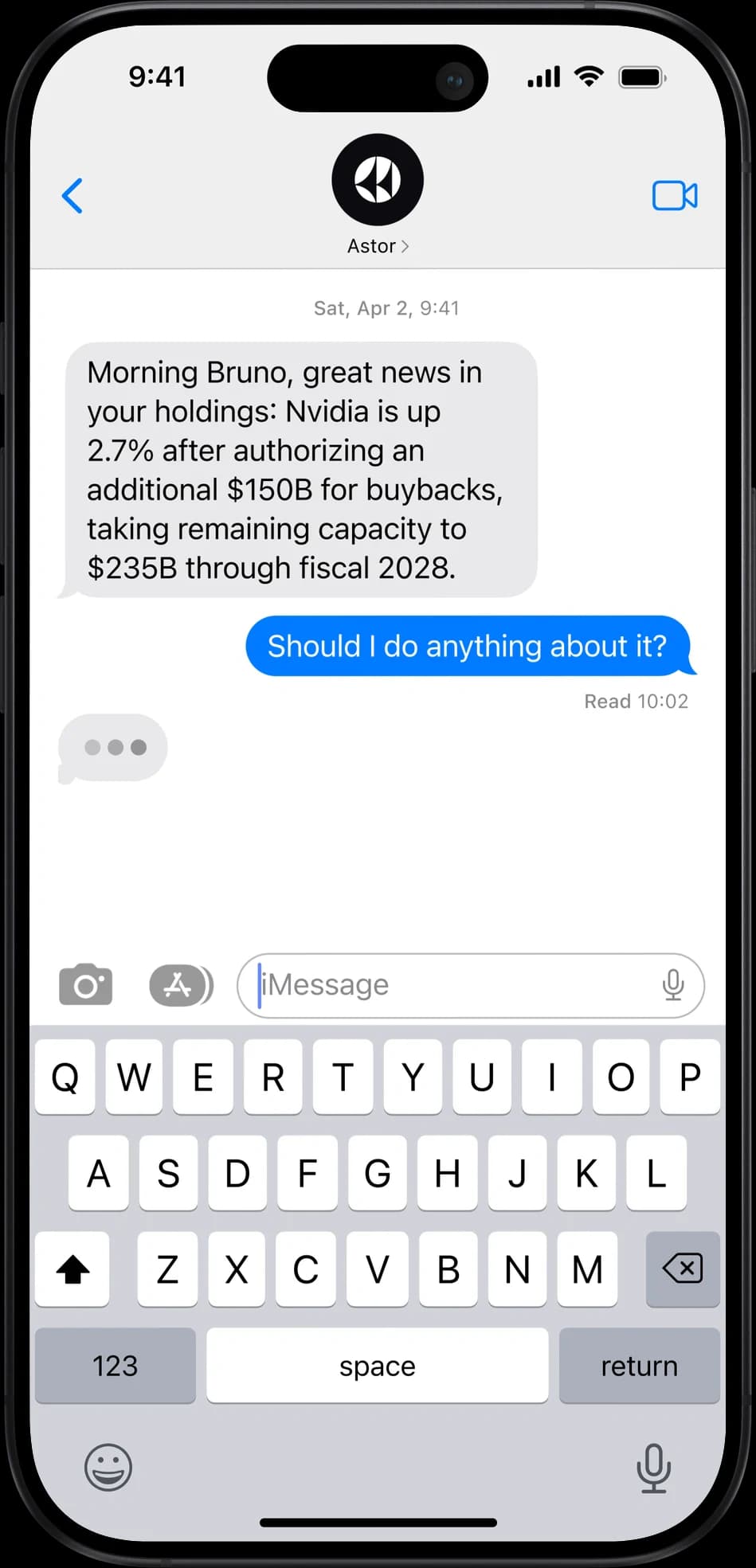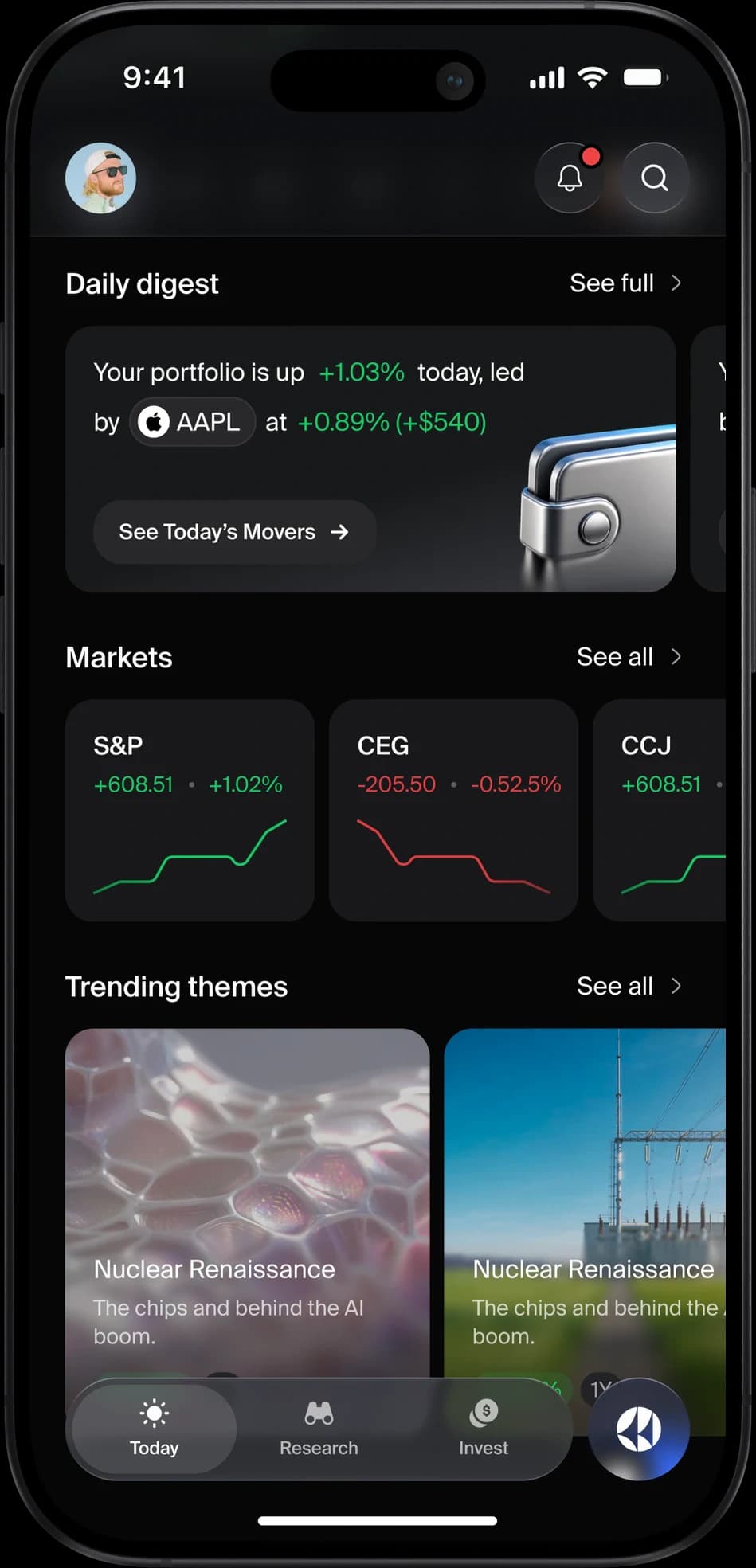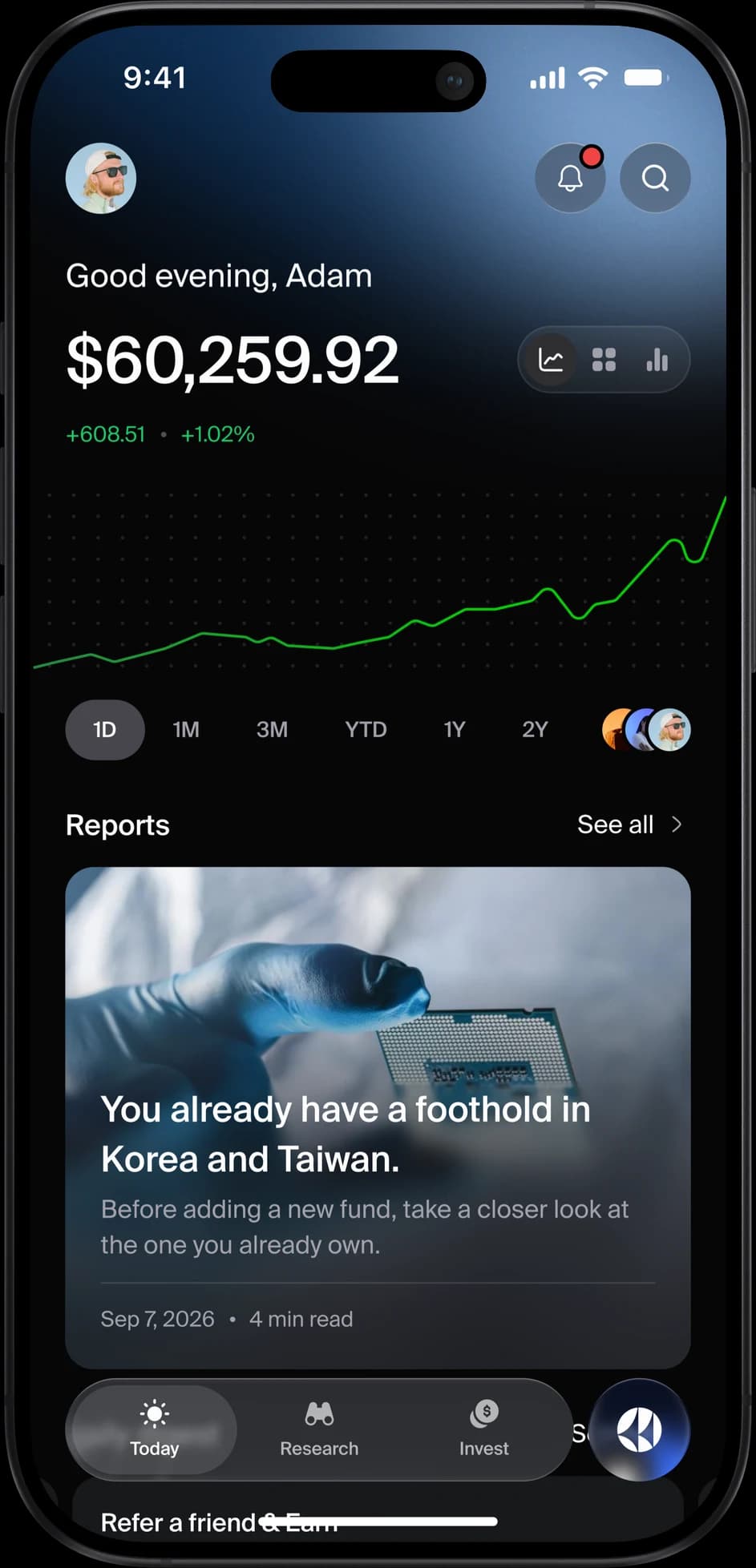
A personal investing agent is AI software that connects to the investment accounts you already have, learns what you own, watches the market for what matters to those holdings, and tells you what happened, why it matters to you, and what you could do. It does the research and the watching, and you make every decision. Astor is a personal investing agent on iPhone and in iMessage, and the company behind it, Gaus, Inc. DBA Astor, is an SEC-registered investment adviser.
The word “agent” is the important part. A chatbot waits for your question, while an agent has a standing job, here keeping an eye on your portfolio, and does it on its own initiative within limits you set. “Personal” means everything it tells you starts from what you actually own.
What does a personal investing agent do?
It does four things.
- It connects to your accounts. It links to your brokerage, retirement and crypto accounts through data networks like Plaid, so it sees your real holdings without your money moving anywhere.
- It learns what you own. It knows your positions across every account and how they group into themes, like AI infrastructure or nuclear power.
- It watches for what matters to you. It follows the earnings dates, filings and headlines that touch your holdings, and tells you when something crosses a line you care about. When nothing matters, it stays quiet.
- It explains and suggests. It tells you what happened, why it matters to your portfolio, and what you could do, with the sources behind each claim. You can ask follow-up questions about your actual holdings.
Some agents can also help you act on an idea, as long as you approve each trade. What a personal investing agent doesn’t do is decide for you.
How is it different from a robo-advisor, a chatbot or a human adviser?
It overlaps with four things people already use.
How is it different from a robo-advisor?
The SEC describes a robo-advisor as an automated advisory program that asks you about your goals, time horizon and risk tolerance, then creates and manages an investment portfolio for you. You open an account with the robo-advisor, and it manages the portfolio based on your answers. That’s a good fit if you want to hand over the day-to-day decisions.
A personal investing agent is built for the opposite preference. Your money stays in the accounts you already have, you keep choosing your own investments, and the agent doesn’t rebalance, trade or manage anything on its own. More in robo-advisor vs. AI investing agent vs. financial advisor, Astor vs. Wealthfront and Astor vs. Betterment.
How is it different from ChatGPT or another AI chatbot?
General chatbots have gotten closer. In the US, ChatGPT’s Finances feature can connect your accounts through Plaid and review your allocation, and Perplexity lets users in the US and Canada link brokerage accounts through Plaid too. Both can send you updates, mostly through scheduled tasks and alerts you set up yourself.
Two differences remain. A chatbot is general-purpose, so watching your portfolio is something you configure rather than the thing it’s for. And OpenAI says ChatGPT isn’t a fiduciary or a registered investment adviser, while Perplexity says its finance data isn’t investment advice. When a personal investing agent is offered by a registered investment adviser, its recommendations are personalized advice and the firm owes you a fiduciary duty. More in Astor vs. ChatGPT and Astor vs. Perplexity Finance.
How is it different from your brokerage’s AI assistant?
Some brokerages now build an assistant into their app. Robinhood’s Cortex, for example, is available to Robinhood Gold members ($5 a month) and can give portfolio insights, monitor market moves and news that may affect your portfolio, and prepare orders that you review and submit. Robinhood says Cortex can’t give buy or sell recommendations and isn’t an investment adviser.
A brokerage assistant lives inside that brokerage’s app, so if you also have a 401(k) or crypto elsewhere, it sees only one piece of the picture. A personal investing agent sits across all of your accounts. More in AI investing apps that work with your brokerage.
How is it different from a human financial adviser?
A human investment adviser gives ongoing advice about buying, selling and holding investments, monitors how your investments line up with your goals, and often offers financial planning too, according to the SEC’s Investor.gov. Registered advisers are required to act in your best interest. A good adviser brings judgment about your whole life, from taxes and estate planning to the hard choices where you want a person to talk to. A personal investing agent doesn’t replace that.
What an agent offers is narrower. It follows every position you own and reaches you by text when something matters. Investor.gov notes that advisers’ fees are typically based on the value of the assets in your account, while Astor charges a flat subscription. If you want a person, a human adviser is the right choice, and if you want to keep making your own decisions with something watching what you own, an agent fits. More on costs in how much an AI financial advisor costs.
Personal investing agent vs. the alternatives
| Personal investing agent | Robo-advisor | AI chatbot | Brokerage AI assistant | Human adviser | |
|---|---|---|---|---|---|
| Main job | Watching and explaining what you own | Building and managing a portfolio for you | Answering questions on almost anything | Helping you use one brokerage’s app | Ongoing advice, often with planning |
| Who makes decisions | You | The robo-advisor manages the portfolio | You | You | Depends on your agreement |
| Sees your holdings | All connected accounts | The account it manages | If you connect or paste them | That brokerage’s accounts | What you share with them |
| Tells you when something matters | Yes, without being asked | Varies | Mostly through tasks or alerts you set up | Varies | Varies |
| Fiduciary duty | Only if the company is a registered adviser (Astor is) | Registered robo-advisors have one | ChatGPT doesn’t, according to OpenAI | Cortex isn’t an adviser, according to Robinhood | Registered advisers have one |
| Example | Astor | Wealthfront, Betterment | ChatGPT, Perplexity | Robinhood Cortex | An adviser you hire |
What should you look for in a personal investing agent?
- Registration. Check whether the company is a registered investment adviser on the SEC’s Investment Adviser Public Disclosure site. The SEC, NASAA and FINRA have warned that securities laws generally require investment firms to be registered, and that a lack of registration should prompt more investigation.
- Read-only access. The agent should connect through an established network like Plaid and be able to see your accounts without moving money or trading in them. Here’s what to check before you connect.
- Your approval for every decision. Nothing should be bought or sold without your explicit yes, and any trading should be limited to money you’ve set aside for it.
- Sources shown. Every alert and answer should link to the filings, prices and news behind it. The same regulators’ alert warns that AI-generated information “can be faulty, or even completely made up,” and suggests confirming the underlying sources before you act.
- Clear pricing. Know whether you pay a flat subscription or a percentage of your assets, and what’s included in each plan.
- Security. Look for an independent SOC 2 Type II report, encryption in transit and at rest, and a clear statement on whether the company sells your data.
What are the limits?
The AI can be wrong. It can misread a filing, weigh a headline badly or miss context, which is why a good agent shows its sources and leaves the decision to you.
It isn’t a full financial plan. A personal investing agent focuses on your investments, so it won’t handle budgeting, tax filing or estate planning.
It doesn’t hold or manage your money. If you’d rather someone else make the decisions, a robo-advisor or a human adviser is the better fit.
And it’s only as good as its data. Any agent, Astor included, can only see what your institution shares through the aggregator, and OpenAI’s help center notes that some institutions share balances but not full holdings or transaction history.
How Astor works as a personal investing agent
Astor connects to brokerage, retirement and crypto accounts at most major US institutions, such as Robinhood, Schwab and Coinbase, through Plaid. It can see your holdings, and it can’t move money. You don’t transfer anything to Astor.
At a glance gives you a five-second check of your portfolio with the Astor Take, two lines on what moved your money today and why, plus a daily brief before the open and a recap after the close. Astor follows every position you own and texts you in iMessage when something crosses a line you care about, and scheduled alerts let you ask for checks on your own schedule. Every alert links to the reasoning and sources behind it.
With Text to Trade, launching in October 2026, you describe an idea and Astor proposes a basket sized against what you already own and the budget you set. You review and approve every trade, and the order executes in your own Robinhood agentic account.
Astor is free to start, works on iPhone and in iMessage, and is available in the US only. You can see how it works.
Frequently asked questions
Is a personal investing agent the same as a robo-advisor?
No. A robo-advisor creates and manages a portfolio for you, usually in an account you open with it. A personal investing agent connects to the accounts you already have, watches what you own and tells you when something matters, and you make every decision.
Does a personal investing agent trade for me?
It shouldn’t trade without your approval. Astor can’t trade or move money in the accounts you connect. With Astor’s Text to Trade, you approve each trade, the order executes in your own Robinhood agentic account, and the agent can only use the money you set aside for it.
Is a personal investing agent a fiduciary?
Only if the company behind it is a registered investment adviser. Astor is an SEC-registered investment adviser (CRD #338424), so its recommendations are personalized investment advice and it owes clients a fiduciary duty. You can check any firm on the SEC’s Investment Adviser Public Disclosure site, and registration doesn’t mean the SEC endorses a firm.
How much does a personal investing agent cost?
It varies by product. Astor is free to start, with Pro at $19 a month ($10 a month billed yearly) and Max at $29 a month ($19 a month billed yearly). It’s a flat subscription, never a percentage of your assets.
Sources
- Investor.gov (SEC): Investor Bulletin, Robo-Advisers (February 23, 2017), accessed Oct 12, 2026
- Investor.gov (SEC): Investment Advisers, accessed Oct 12, 2026
- Investor.gov (SEC, NASAA and FINRA): Artificial Intelligence (AI) and Investment Fraud, Investor Alert (January 25, 2024), accessed Oct 12, 2026
- OpenAI Help Center: Finances in ChatGPT, accessed Oct 12, 2026
- OpenAI Help Center: Scheduled tasks in ChatGPT, accessed Oct 12, 2026
- Perplexity: Perplexity Finance, accessed Oct 12, 2026
- Perplexity changelog: Computer for Pro subscribers, Computer for Slack (March 13, 2026), accessed Oct 12, 2026
- Robinhood: Robinhood Cortex, accessed Oct 12, 2026
- SEC Investment Adviser Public Disclosure: Astor (CRD 338424), accessed Oct 12, 2026
Important information
Gaus, Inc. DBA Astor is an SEC-registered investment adviser (CRD #338424). Registration does not imply a certain level of skill or training. Astor provides non-discretionary advice: you make every investment decision. All investing involves risk, including the loss of principal, and past performance does not guarantee future results. Astor uses AI, which can make mistakes. This article is general information, not individualized investment, tax or legal advice. See our disclosures.
About comparisons
Information about other companies comes from their public websites and filings as of October 2026 and may have changed since; check each provider for current details. Comparisons and rankings reflect Astor’s opinion. Other companies’ names and trademarks belong to their owners, and no affiliation or endorsement is implied.
Share