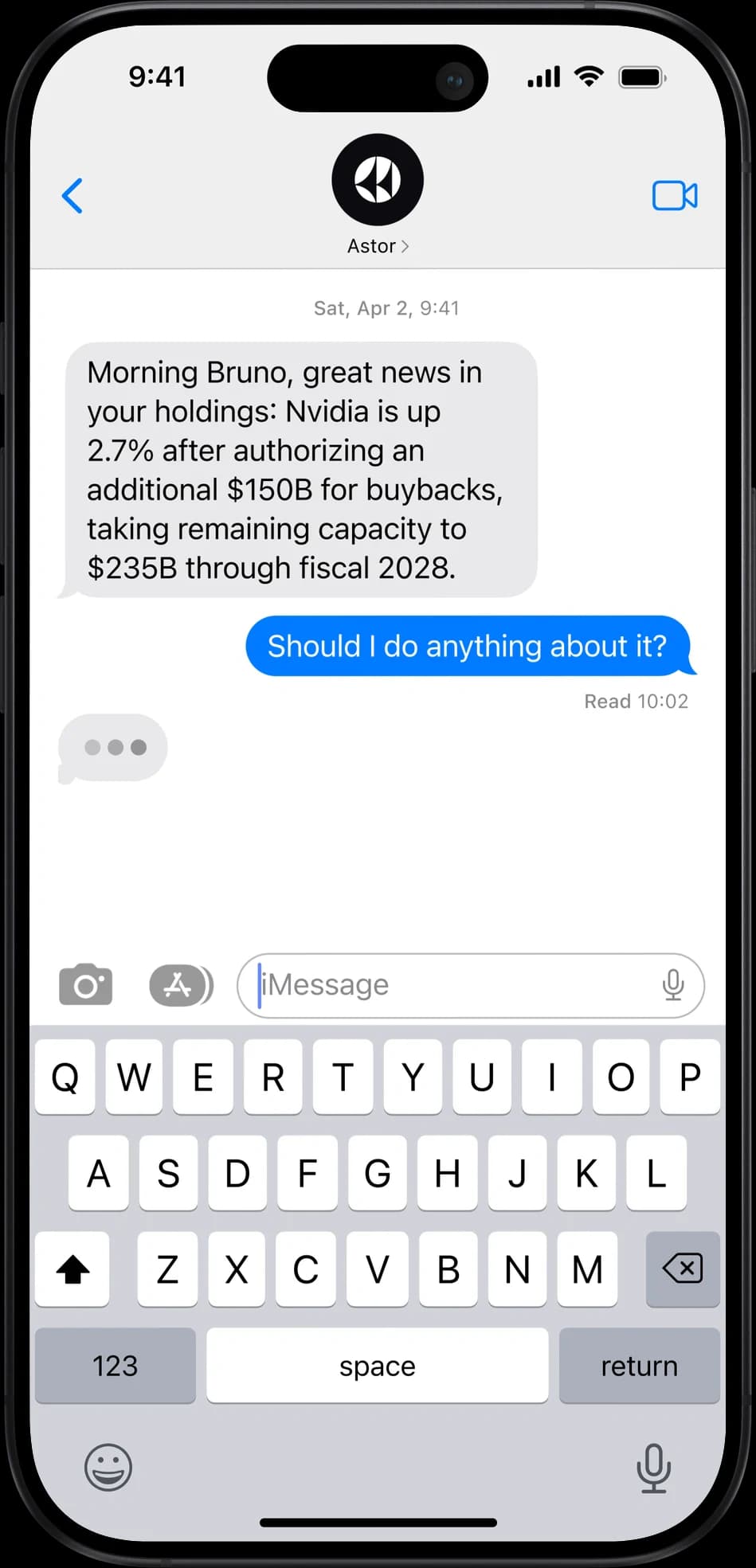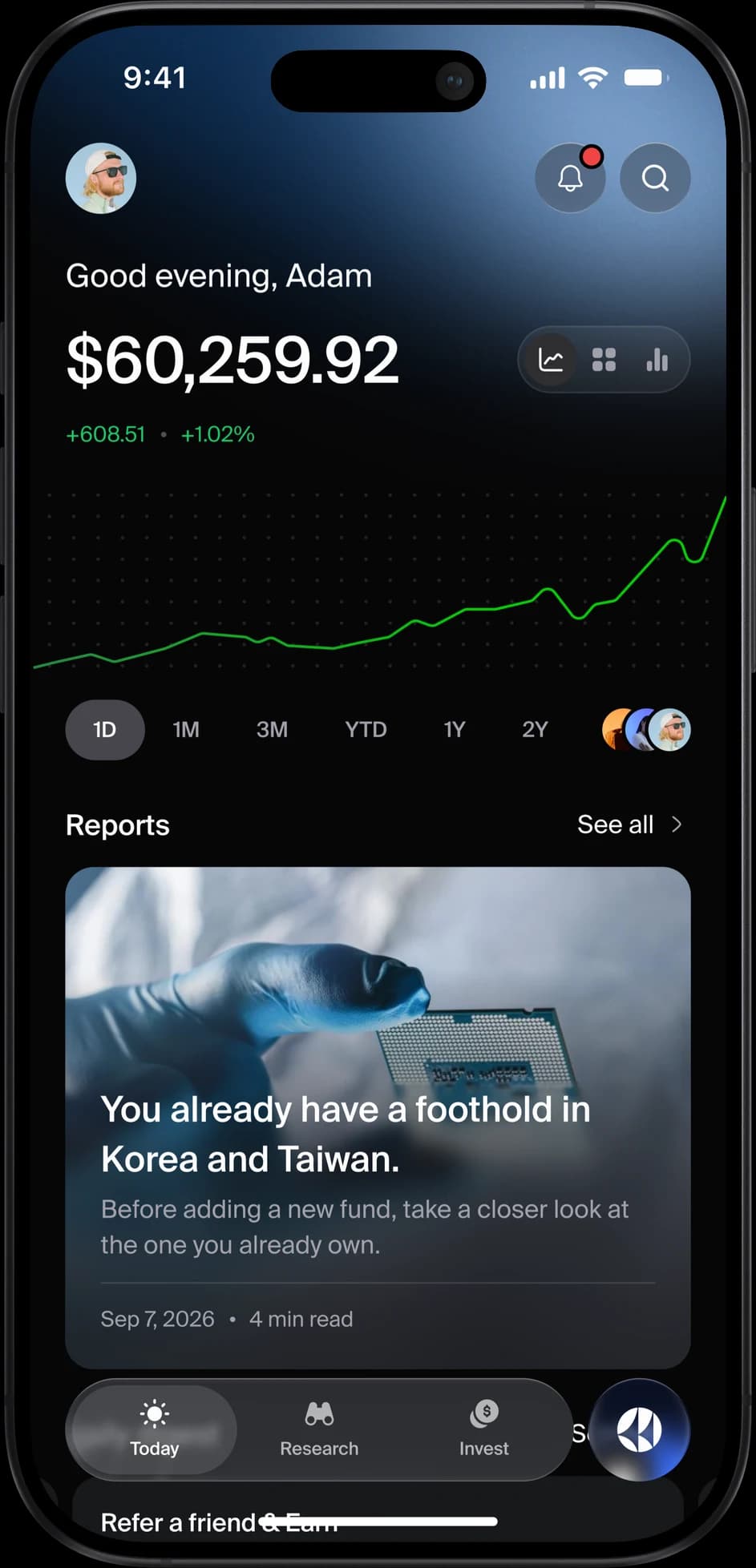
Scheduled alerts let you ask Astor to check something for you on a schedule, or when a condition is met, and text you what it found. Astor is a personal investing agent on iPhone and in iMessage, and it already watches every position you own; scheduled alerts add the specific checks you care about, like a look at a company the day before it reports earnings.
A classic price alert starts from a ticker and a number. That’s useful, but a price crossing a line rarely tells you what you actually want to know, which is whether something changed for a company you own and whether it matters for you. We built scheduled alerts around questions instead of thresholds.
What can you schedule?
You can schedule anything you’d otherwise have to remember to check. You set it up by asking Astor in plain English, the same way you’d ask it anything else. Here are a few hypothetical requests:
- “Every morning before the open, tell me if there’s news on my five biggest positions.”
- “Every Friday, recap what happened this week to the companies in my AI infrastructure theme.”
- “The day before any company I own reports earnings, remind me what to watch for.”
- “Text me if any single stock grows past 20% of my portfolio.” (The 20% is illustrative.)
The first three run on a schedule, and the last one waits for a condition instead of a date.
How is a scheduled alert different from a price alert?
A price alert tells you that a number was crossed. A scheduled alert is a question Astor answers at a set time or when a condition is met, using what you own along with live prices, news and filings.
Say a stock you own drops 8% in a morning (an illustrative number). A price alert tells you it moved. An alert from Astor tells you why it moved, how much of your portfolio that position is, and what you could do, which might well be nothing. If all you want is a ping at an exact price, a simple price alert may be all you need.
How do earnings alerts work for stocks you own?
US public companies file a quarterly report with the SEC for each of the first three quarters of their fiscal year, plus an annual report after the fourth. So if you own 15 stocks (an illustrative number), that’s roughly 60 reports a year.
Astor already follows the earnings dates of every position you own. On top of that, you can ask for a check before a company reports, so you know what to watch for going in. Astor can also schedule its own follow-up after a company you own reports, so you hear what changed without having to ask.
Here’s a hypothetical. Say you own a software company that reports after the close on Thursday. You could ask Astor for a note that morning on what to watch for. After the results are out, Astor can set itself a check-in and text you what changed and whether it matters for your position.
How do scheduled alerts fit with the rest of Astor?
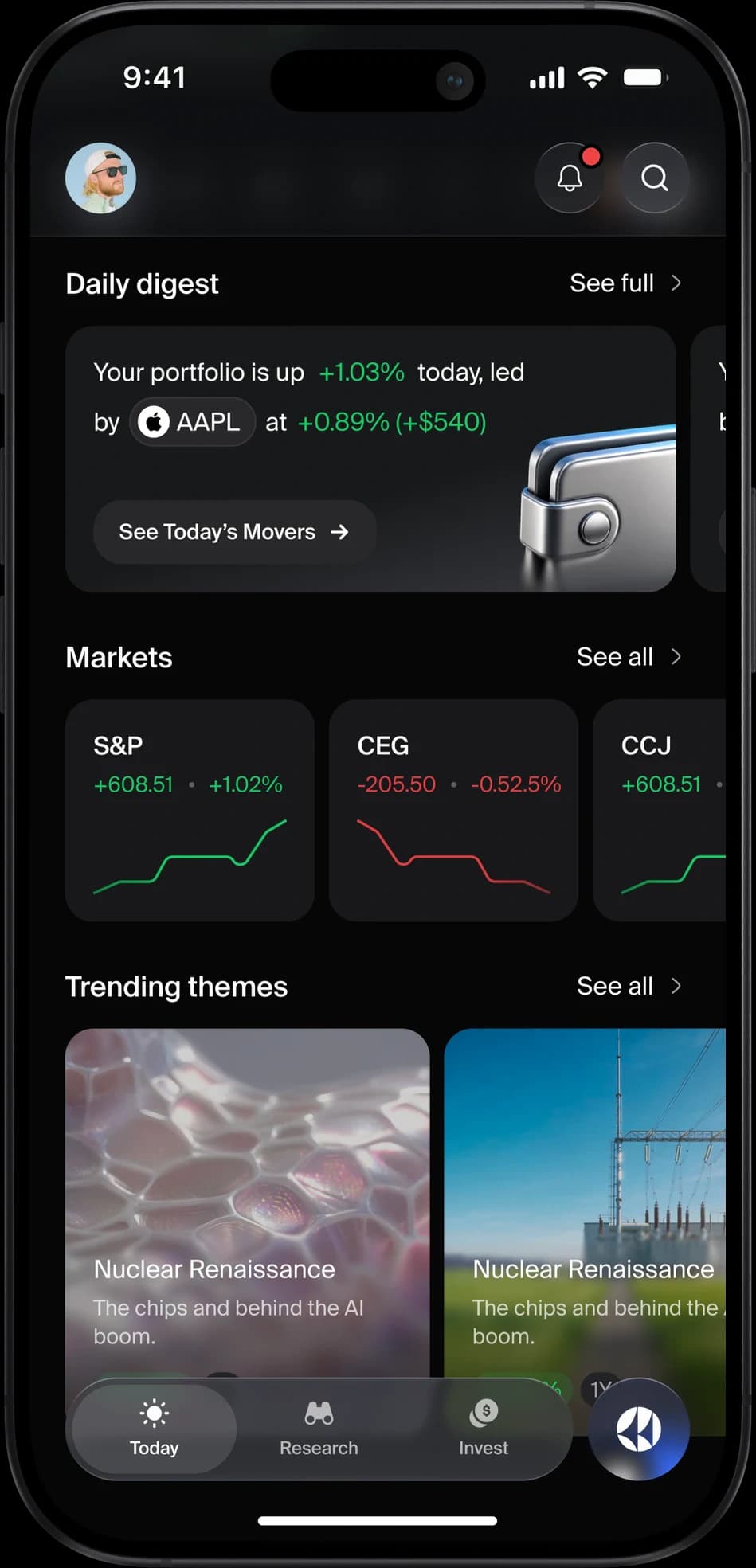
Astor already follows every position you own and the headlines and filings that touch them, and it texts you right away when something crosses a line you care about. We cover that in stock alerts for news on stocks you own. Scheduled alerts are for the checks you want on your own terms. If you talk to Astor in iMessage, alerts come to that same thread, so you can reply with a follow-up question right there. For a daily picture, At a glance gives you two lines on what moved your money today, plus a brief before the open and a recap after the close.
What are the limits?
“Never miss a move” is what we’re aiming for, and it’s not a guarantee. Astor can only check what it can see, which means the accounts you connect and public prices, news and filings. Markets can move faster than any text, and the AI can be wrong about why something happened, which is why every alert links to its reasoning and sources.
An alert is information, not an instruction. Astor is an SEC-registered investment adviser, and it doesn’t trade or decide for anyone. Astor can’t trade or move money in your connected accounts, so an alert can’t buy or sell anything. You make every decision.
Astor is iPhone and iMessage only, in the US.
Frequently asked questions
Is there an app that sends earnings alerts for stocks I own?
Yes. Astor follows the earnings dates of every position you own through its connections to your accounts. You can schedule a check before a company reports, and Astor can schedule its own follow-up after the results come out.
How many custom alerts can I set on the free plan?
The free plan includes one custom alert, and you can compare paid plans on the pricing section of our home page.
Will Astor text me every time a stock moves?
No. Astor texts you when something crosses a line you care about, and it stays quiet when nothing matters. Scheduled alerts add the checks you ask for, on the schedule or condition you set.
Can an alert buy or sell a stock for me?
No. Alerts are information, and you make every decision. Astor can see the holdings in your connected accounts but can’t move money or place trades in them.
Sources
- Investor.gov (SEC): Form 10-Q, accessed Oct 12, 2026
- SEC Investment Adviser Public Disclosure: Gaus, Inc. (CRD 338424), accessed Oct 12, 2026
Important information
Gaus, Inc. DBA Astor is an SEC-registered investment adviser (CRD #338424). Registration does not imply a certain level of skill or training. Astor provides non-discretionary advice: you make every investment decision. All investing involves risk, including the loss of principal, and past performance does not guarantee future results. Astor uses AI, which can make mistakes. This article is general information, not individualized investment, tax or legal advice. See our disclosures.
Share