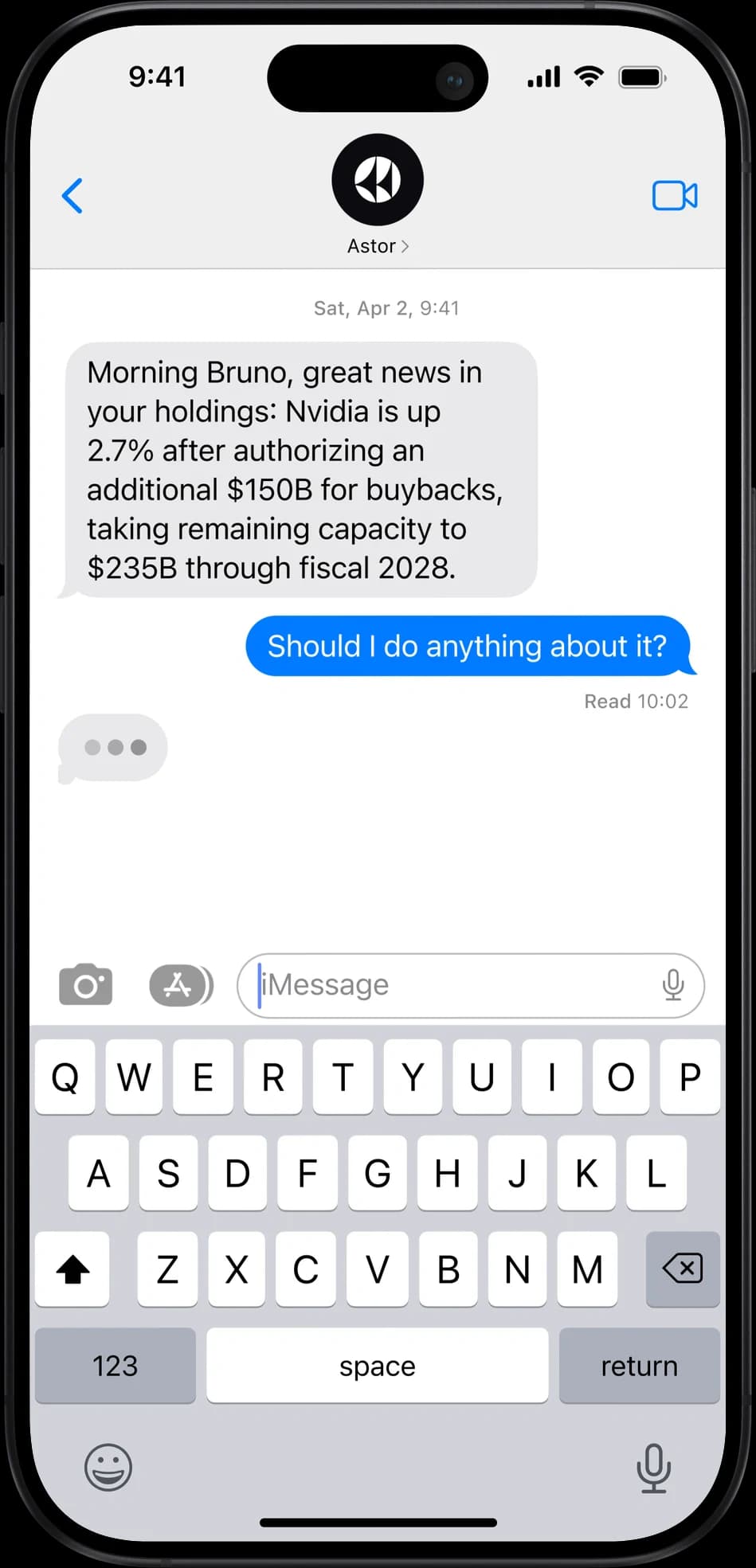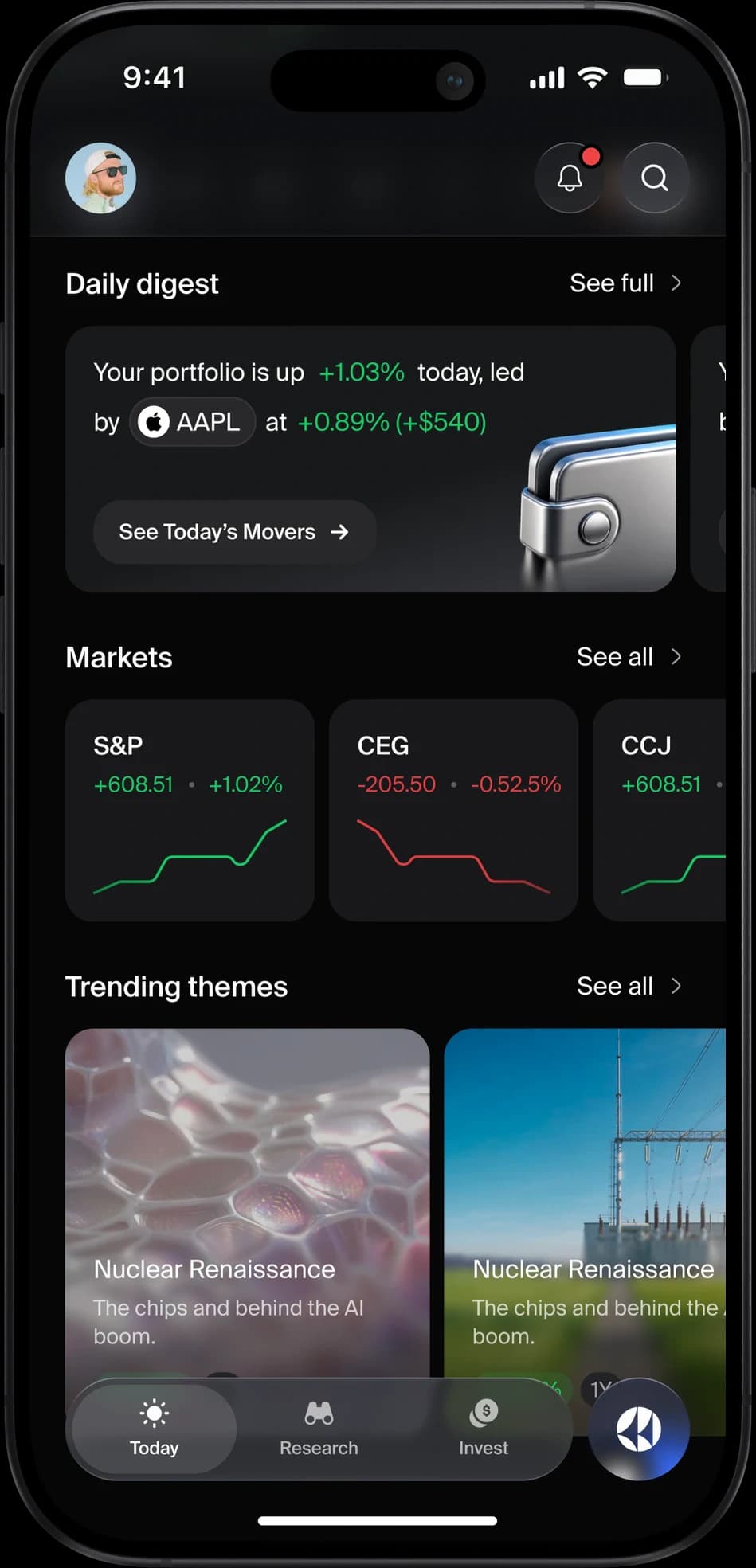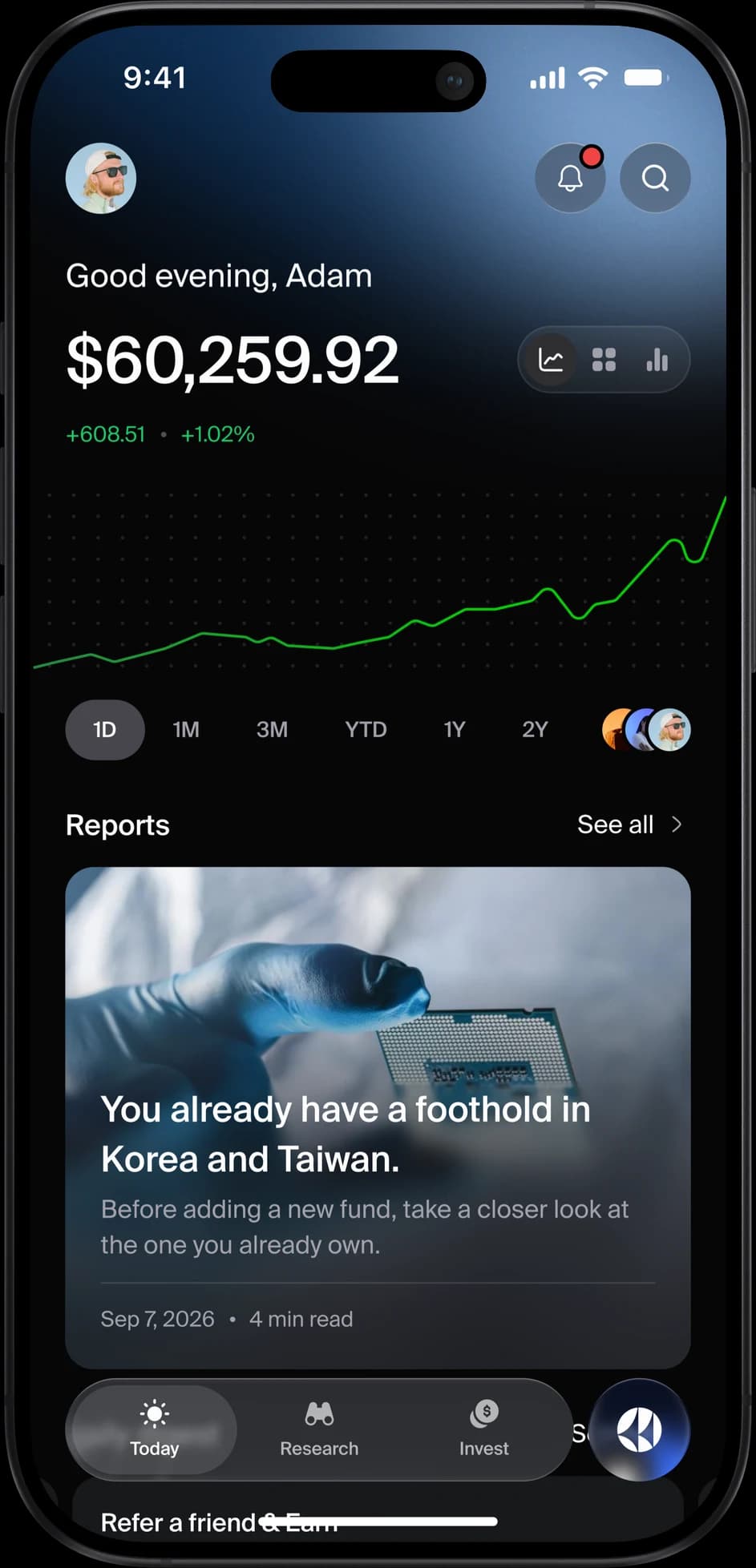
Robo-advisors like Wealthfront and Betterment manage money you move into an account with them, AI built into a brokerage works with the accounts at that firm, and aggregator-based apps connect to the accounts you already have. Astor is in the last group: it’s a personal investing agent from an SEC-registered investment adviser that connects to your existing brokerage, retirement and crypto accounts, watches what you own, and texts you when something matters, while your money stays where it is.
Which one fits depends on whether you want someone to manage the money or help with the accounts you already run yourself.
Do robo-advisors work with the account you already have?
Not for managing it. A robo-advisor invests the money in an account you open and fund with it, and your existing accounts can be linked for context.
Wealthfront‘s Automated Investing Account starts at $500 and charges a 0.25% annual advisory fee. You can link all your accounts in the app to see your net worth, and its planning tools, free for clients, use those links to project your net worth over time.
Betterment charges $5 a month for investing accounts, or 0.25% a year once your household balance reaches $24,000 or you set up $200 or more in monthly recurring deposits, with no minimum balance. Premium is 0.65% a year with a $100,000 minimum. You can sync external accounts to your goals, which Betterment says helps it give better advice, but its disclosure says its advisory services don’t incorporate specific investments you hold elsewhere. Betterment’s AI insights analyze the portfolio you’re building, not your external accounts, and don’t include recommendations.
That’s the right setup if you want the investing done for you. The trade-off is that you move money, and moving a taxable account to a new manager can mean selling positions and owing tax on the gains.
Which brokerages have their own AI, and what can it see?
Several big brokers now have an assistant, and each is documented to work with that firm’s accounts.
- Robinhood. Cortex Assistant (with Gold, $5 a month) analyzes holdings across your Robinhood accounts, and Portfolio Digests use information from your Robinhood account. Robinhood Agents can view all your Robinhood accounts. Robinhood says Cortex Assistant isn’t an investment adviser.
- Schwab. Charley, announced September 30, 2026, is rolling out in phases to eligible US retail clients and answers questions about balances, transactions and positions, grounded in Schwab’s data.
- Public. Its AI Agents are wired to your Public portfolio and need your sign-off before running. Public says their outputs aren’t investment recommendations or advice.
- Webull. Vega is a free built-in assistant for US customers, and Webull’s connectors let you bring your Webull account into ChatGPT, Claude and Grok.
Some brokers do look outside their walls. Fidelity’s Full View aggregates accounts held elsewhere at no extra charge, though it’s a tracking tool, not an AI. SoFi Coach is an AI chat for SoFi Plus members that can connect accounts from more than 12,000 institutions, and SoFi says it doesn’t provide investment advice or recommendations.
If nearly all your money sits at one broker, its own AI is the simplest option. If it’s spread across a brokerage, a 401(k) and a crypto account, a single broker’s assistant sees only part of the picture.
Which AI apps read across all your accounts?
These connect through aggregators like Plaid, so your money stays where it is.
Origin connects brokerage, retirement and crypto accounts through partners including Plaid, MX and Mastercard, and says the connections are read-only by design. Its AI gives plain-language insights on allocation and risk alongside budgeting and planning, its advice is non-discretionary, and advisory services come through Origin Investment Advisory LLC, an SEC-registered adviser. It also offers its own investment accounts. As of October 2026 its homepage shows a limited-time price of $1 for the first year, against a listed $99.
Perplexity connects brokerage accounts through Plaid with read-only access, on desktop for signed-in users in the US and Canada. Basic portfolio features are free, and more advanced features are part of Pro and Max.
ChatGPT has a Finances feature for US users on its Free, Go, Plus and Pro plans that connects accounts through Plaid. OpenAI says ChatGPT can’t move money, place trades or act as an investment adviser.
Budgeting apps also aggregate investments. Monarch connects to more than 13,000 institutions and has an AI Assistant ($99.99 a year or $14.99 a month), and Empower’s dashboard is free.
How do they compare?
Facts as of October 2026, from each provider’s official pages.
| Works with your existing accounts | Do you move money? | Registered adviser behind recommendations | Cost | |
|---|---|---|---|---|
| Wealthfront | Links outside accounts for net worth and planning | Yes, for managed investing ($500 minimum) | Yes, Wealthfront Advisers LLC | 0.25%/year |
| Betterment | Syncs outside accounts to goals; advice doesn’t cover specific outside holdings | Yes, for managed investing | Yes, Betterment LLC | $5/month or 0.25%/year |
| Robinhood Cortex | Robinhood accounts | Only to use it at Robinhood | No; Robinhood says Assistant isn’t an investment adviser | Gold, $5/month |
| Schwab Charley | Schwab accounts | Only to use it at Schwab | Not stated | Not stated |
| Origin | Brokerage, retirement and crypto via Plaid, MX and Mastercard | No, though it also offers its own accounts | Yes, Origin Investment Advisory LLC | $1 first year (limited-time; listed at $99) |
| Perplexity | Brokerage accounts via Plaid, read-only | No | Not stated | Free; advanced features on Pro and Max |
| ChatGPT Finances | Accounts via Plaid (US); can’t move money or trade | No | No; OpenAI says it can’t act as an investment adviser | Free, Go, Plus and Pro plans |
| Astor | Links to most major US brokerage, retirement and crypto accounts | No | Yes, Gaus, Inc. (Astor) | Free to start; Pro $19/month, Max $29/month |
When is a robo-advisor or your broker’s AI the better choice?
If you want someone to pick and rebalance a portfolio for you, a robo-advisor like Wealthfront or Betterment is built for that, and Astor doesn’t run a managed portfolio. If almost everything you own is at one broker, its built-in assistant is already there. If you want budgeting, net worth and financial planning in one app, Origin or Monarch covers more ground, since Astor doesn’t do budgeting, tax filing or estate planning. And if you’re on Android or the web, Astor is iPhone and iMessage only.
Our robo-advisor vs. AI investing agent vs. financial adviser guide, plus Astor vs. Wealthfront and Astor vs. Betterment, go deeper on these trade-offs.
Why Astor
Astor is built for people who already invest on their own and want help with the accounts they have. It’s a personal investing agent: it connects through Plaid to brokerage, retirement and crypto accounts at most major US institutions, like Robinhood, Schwab and Coinbase, and learns what you own across all of them. You don’t transfer anything to Astor, and it can’t move money.
From there it watches every position and the earnings dates, filings and headlines that touch them, and texts you what happened, why it matters to you, and what you could do. You can ask about your actual holdings in chat or in iMessage, and every alert links to the reasoning and sources behind it, because the AI can be wrong and you make the call. Astor is offered by Gaus, Inc., an SEC-registered investment adviser, so its recommendations are personalized advice and the firm owes you a fiduciary duty. It’s free to start, and paid plans are a flat subscription, never a percentage of your assets.
Frequently asked questions
Can an AI investing app see my brokerage account without moving my money?
Yes. Apps that use read-only connections through providers like Plaid can see your holdings without being able to move money. Origin and Perplexity describe their connections as read-only, Astor can’t move money in the accounts you connect, and OpenAI says ChatGPT’s Finances feature can’t move money or make trades.
Do Wealthfront and Betterment advise on accounts I hold elsewhere?
Both let you link outside accounts to see your full picture. Betterment’s disclosure says its advisory services don’t incorporate specific investments you hold elsewhere, and their managed investing applies to money in accounts you hold with them.
Is it safe to connect my brokerage account to an AI app?
Look for read-only access, a known connection provider, and a clear statement that the app can’t move money or trade. Our guide on whether it’s safe to connect your brokerage account walks through what to check.
Can Astor place trades in my accounts?
Not in your connected accounts, where Astor can see your holdings but can’t trade or move money. The one exception is Text to Trade, launching October 2026, where you approve every trade and the order executes in your own Robinhood agentic account. See which AI can build a trading strategy and execute it in Robinhood.
Sources
- Wealthfront: Wealthfront Fees, accessed Oct 12, 2026
- Wealthfront: Serious investing made seriously easy, accessed Oct 12, 2026
- Wealthfront: Free Financial Planning Tools & Advice, accessed Oct 12, 2026
- Wealthfront: Full Disclosure, accessed Oct 12, 2026
- Betterment: Betterment’s Pricing, accessed Oct 12, 2026
- Betterment: What are Betterment’s fees?, accessed Oct 12, 2026
- Betterment: Can I sync my external accounts to my goals?, accessed Oct 12, 2026
- Betterment: Is there an AI feature that analyzes my portfolio?, accessed Oct 12, 2026
- Robinhood: Robinhood Cortex Assistant Disclosure, accessed Oct 12, 2026
- Robinhood Support: Cortex Digests, accessed Oct 12, 2026
- Robinhood Support: Robinhood Agents overview, accessed Oct 12, 2026
- Charles Schwab Pressroom: Meet Charley, Schwab’s New AI-Powered Assistant, accessed Oct 12, 2026
- Public: AI Agents for Investing, accessed Oct 12, 2026
- Webull: Webull Unveils Vega, the Next Evolution of Its AI-Powered Decision Partner, accessed Oct 12, 2026
- Webull: Webull Launches ChatGPT, Claude & Grok Connectors, CLI, and Enhanced MCP, accessed Oct 12, 2026
- Fidelity: New Full View, accessed Oct 12, 2026
- SoFi: Introducing SoFi Coach, accessed Oct 12, 2026
- Origin: Origin Financial home page, accessed Oct 12, 2026
- Origin: Investment Tracking, High-Yield Cash Account & AI Insights, accessed Oct 12, 2026
- Origin: Introducing the first AI financial advisor with full-context reasoning regulated by the SEC, accessed Oct 12, 2026
- Origin: Is an AI financial advisor safe to use with my real bank account?, accessed Oct 12, 2026
- Perplexity: Computer is Now Your Personal CFO, accessed Oct 12, 2026
- OpenAI Help Center: Finances in ChatGPT, accessed Oct 12, 2026
- Monarch: Monarch Pricing, accessed Oct 12, 2026
- Monarch: Easier Bank Connections, a Faster AI Assistant, and more, accessed Oct 12, 2026
- Empower: Financial Tools, accessed Oct 12, 2026
- SEC Investment Adviser Public Disclosure: Wealthfront Advisers LLC (CRD 148456), accessed Oct 12, 2026
- SEC Investment Adviser Public Disclosure: Betterment (CRD 149117), accessed Oct 12, 2026
- SEC Investment Adviser Public Disclosure: Origin Investment Advisory LLC (CRD 305353), accessed Oct 12, 2026
Important information
Gaus, Inc. DBA Astor is an SEC-registered investment adviser (CRD #338424). Registration does not imply a certain level of skill or training. Astor provides non-discretionary advice: you make every investment decision. All investing involves risk, including the loss of principal, and past performance does not guarantee future results. Astor uses AI, which can make mistakes. This article is general information, not individualized investment, tax or legal advice. See our disclosures.
About comparisons
Information about other companies comes from their public websites and filings as of October 2026 and may have changed since; check each provider for current details. Comparisons and rankings reflect Astor’s opinion. Other companies’ names and trademarks belong to their owners, and no affiliation or endorsement is implied.
Share